
Gaelic football betting odds – what the price actually costs you
 Available in US
A bookmaker’s odds on a GAA match are a number with a margin baked into them. The punter’s job is to spot that margin, decide whether the price is fair for the bet being placed, and choose a bookmaker whose terms do not claw the value back through minimum prices, wagering conditions or payout rules. This page works through Gaelic football betting odds in that order: first how a price is built, then how match, outright and in-play markets are settled, then the licensed UK bookmakers that carry the sport, ending with what their welcome offers actually pay out once the small print is applied.

The data below is current as of October 30, 2026 and has been checked against the Gambling Commission’s public register of operating licences.
How Gaelic football odds are priced and what the margin takes
A decimal price is what a winning one-pound stake returns, stake included. At 6.00 the bookmaker returns £6 for a £1 bet; at 1.91 the same £1 returns £1.91. The stake is paid back on every win at a licensed bookmaker; on a free bet the stake usually is not, which is covered in its own section below.
Fractional odds say the same thing in a different shape. Five-to-one (5/1) returns five pounds of profit for every pound staked, with the stake added back on top — the equivalent decimal price is 6.00. Eleven-to-four (11/4) is 3.75 in decimals. Evens (1/1) is 2.00. The conversion rule is straightforward: divide the first number by the second, then add one. Eleven divided by four is 2.75; add one and you get 3.75.
A price on its own is just a number. The two-way match market — home win and away win, draw no bet or any other market with two clean outcomes — is where the cost of betting shows up. Take a fictional two-way market priced at 1.90 against 1.90. The implied probabilities are 1 ÷ 1.90 and 1 ÷ 1.90, which gives roughly 52.6% and 52.6% — totalling about 105.3%. The 5.3% above 100% is the bookmaker’s margin, sometimes called the overround. For every £1 staked across that market in proportion to the implied chances, about 5p is kept by the bookmaker on average. That is the price of having a bet on at all: on a market margined at 5.3%, a bettor who could pick winners at exactly the implied probability still slowly loses 5.3% of turnover. Margins on outright winner markets — the All-Ireland Senior Football Championship, a provincial championship, a Division 1 league — run higher, often between 8% and 15% depending on the field, because each runner adds another outcome to the book. Handicaps, totals and combination markets are priced separately and carry their own margin, which can be tighter or wider than the head-to-head line.
What the margin does in practice: at 1.90 and 1.90 the bettor needs to win 52.6% of the time at those exact prices just to break even. Pick winners at 55% and a £10 stake on each match returns a £10 profit over a long run of 100 bets; pick at 50% and the same staking loses around £53. The arithmetic is not a tip. It is what the margin costs.
Margin lives on the same axis as the price. A two-way price of 1.95 against 1.95 carries a margin of about 2.5%; a price of 1.80 against 1.80 carries a margin of about 11.1%. The further the price moves from 2.00, the more the bookmaker keeps — and the more often the bettor has to be right to come out level. GAA bookmakers typically price head-to-head match odds tighter than outright markets for that reason: the field is smaller, the form is shorter, the book is easier to balance. Looking at one price in isolation tells the punter nothing; comparing two prices for the same match tells them everything.
Gaelic football has a quirk the punter should know before reading a line. A goal (the ball into the net under the crossbar) is worth three points; a point (the ball over the crossbar between the uprights) is worth one. The scoreline reads goals-points. Mayo beat Kerry 1-20 to 1-17 in the 2026 All-Ireland Senior Football Championship final — four points apart, but a one-goal margin is three points and a point is one, so the score gap can look small in points while one side has run up a goal difference. Since 2025 shots from outside the new 40-metre arc are worth two points, which has lengthened a few handicap markets and made some totals harder to read. Spread bets and handicaps that price by total score need the rule in mind: a three-point swing in the modern game requires more than the three-point goal it would have required under the older arc rule.
Markets on Gaelic football at licensed UK bookmakers
There is no statutory list of permitted sports in Great Britain. A bookmaker licensed by the Gambling Commission may carry whatever real-events markets its own trading team and licence conditions allow — Gaelic football, GAA hurling, the National Football League and the All-Ireland Senior Football Championship are not on any list and not off any list. The shape of the offering comes from the bookmaker, not the regulator.

Senior inter-county Gaelic football matches last seventy minutes — two halves of thirty-five minutes each. Most adult club games run sixty minutes. Tie games in the championship go to extra time; in the league a draw stands. Markets tend to settle on the result at the end of normal time unless the bookmaker’s rule says otherwise, and that rule is worth a glance on the betting slip before staking. League fixtures can run midweek as well as weekends, and the championship adds a knockout stage from mid-summer onwards.
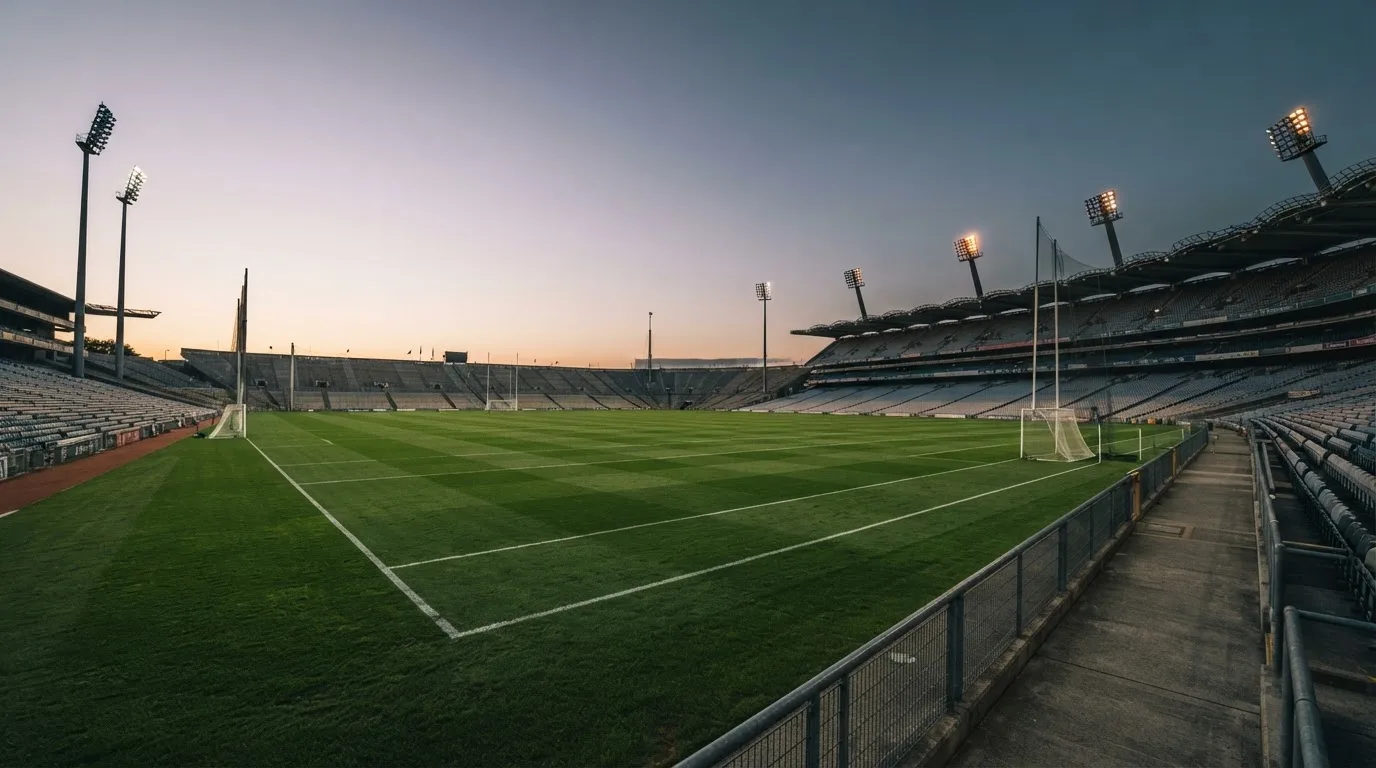
The All-Ireland Senior Football Championship final is the season’s centrepiece, played each year at Croke Park, Dublin. Kerry hold the record for most titles, with thirty-nine. The 2026 final on 26 July 2026 went to Mayo by 1-20 to 1-17, a fourth title for the county. Outright markets priced twelve months out carry a long field and a fat margin; markets priced the morning of the final carry a two-runner field and a tighter one.
The typical menu at a UK-licensed bookmaker runs along these lines, with naming set by each brand:
- Match result (1X2 or home / away): home win, draw where the competition allows one, away win. Most league matches permit a draw; knockout matches are settled at the end of normal time and may carry a “draw no bet” option that refunds stakes on a draw.
- Handicap and spread: a line set in points (-3, +5, etc.), settling on the margin after the goal-point conversion. Good lines on Gaelic football are thin on the ground because the scoring system mixes goals and points, and 3/1 goal-point maths does not translate cleanly to half-point football lines.
- Total points (over / under): a line on combined goals-times-three plus points. Some books separate goals and points; most do not.
- Half-time / full-time: the result at the break and at full-time as a combined bet. Expensive in market terms because of the combination.
- First scorer markets and player props: first goalscorer, first pointscorer, man-of-the-match — offered by the bigger books and named on their GAA pages when a match is live.
- Outright markets: All-Ireland Senior Football Championship winner, provincial championships, divisions, leading scorer awards. Priced for months in advance with a heavy margin.
- Accumulators: same-game multi or bet-builder products let the punter stack several markets from one match into a single price; the legs multiply.
Spread betting on GAA is a separate product, offered by firms licensed by the Financial Conduct Authority on the financial side and the Gambling Commission on the fixed-odds side. The mechanics are different — a buy or sell stake on a margin or total — and the liability is uncapped. Spread betting losses can exceed the original deposit, which is the regulator’s caveat on every spread-bet advert.
Live betting and cash out on GAA
Live betting on Gaelic football at a licensed UK bookmaker runs the same shape as live betting on any other sport: a market that updates during the match, with prices suspended at key moments — a goal, a black card, a substitution, the half-time whistle — and resumed as the in-play trading team re-prices the runners. The trade-off the punter accepts in exchange for live markets is a wider margin: in-play books are typically margined somewhere between 6% and 10% on GAA compared with the 5%-7% a top-priced pre-match bookmaker carries on the same match. The reason is suspension risk — every time the book is closed, the trading team has to absorb the position, and the price charged to the rest of the field reflects that.
Cash out is a feature on top of live markets, not a market in its own right. Settle an open bet before the match finishes at a price the bookmaker sets at that instant. The cash-out price is built from the current live odds less a margin of the bookmaker’s own — usually between 2% and 5% on top of the live margin — and that extra slice is the cost of taking the bookmaker’s price rather than waiting for the match result. Auto cash out lets the punter set a trigger. Bet Builder+ on the bigger apps combines markets from one match into a single in-play bet, which adds another margin layer when the bet is settled early.
In-play markets on Gaelic football are sparse on a Tuesday evening in February; rich on the May bank holiday weekend and the All-Ireland series in July and August. A few bookmakers carry GAA year-round; most add it as the championship approaches.
Welcome offers and free bets on Gaelic football
A welcome offer is the marketing on the way in, and the marketing conceals the cost on the way out. Read the small print before staking.
A matched free bet on a first deposit plus first bet — “bet £5, get £30 in free bets” — is the standard shape. The free bets that arrive are not cash. Their stake is usually not returned with a win: a £10 free bet at 5.0 that wins pays out £40 in profit, the stake is gone, and the value of the offer is the expected profit on the free bet stake at the book’s average margin. The promotion is not free money. It is a marketing budget paid out as a bet that cannot lose the bookmaker its own cash.
The example that shows up most often at a Gaelic-football-friendly bookmaker: deposit £10, place a £10 qualifying bet within seven days at minimum odds, receive four £10 free bets. Two are tagged for football accumulators of four or more selections, two for multiples of two or more. Free bets expire in seven days. Each carries its own minimum-odds rule — usually 1/2 (1.50) or 5/6 (1.83) decimal — and a stake-not-returned condition.
Wagering requirements on bonuses at UK-licensed bookmakers are capped: no more than ten times the bonus amount, under promotion rules in force since 19 January 2026. A £10 bonus needs at most £100 of qualifying bets before any winnings can be withdrawn. The cap is welcome for the punter who otherwise would have seen fifty-times turnover that could not be cleared. Mixed-product promotions — an offer that forces the punter to bet on football to claim casino free spins, for example — are banned under the same set of rules, which removes the worst of the cross-product tricks.
The qualifying-bet rule is the cost most punters do not see. A “bet £10 at minimum odds of 1/2 (1.50)” line locks the punter into a stake on a market that already carries the book’s normal margin, and the qualifying bet has to win for a free bet of the same value to clear. Where a free bet stake is not returned, a £10 free bet won at 5.00 (a fair price for a longshot) is worth about £6.67 in expected value at a 5% margin; the marketing suggests £50, the arithmetic delivers a few pounds. Run the formula on the offer in front of you before claiming.
No promo code is printed here. Promo codes rotate, geo-target, expire and void one another, and the only version worth trusting is the one on the bookmaker’s own offer page at the moment of registration.
Bonuses, price boosts and acca insurance
Price boosts on Gaelic football are short-lived enhanced odds on a single market — a team to win at 5/1 (6.00) instead of 4/1 (5.00) — usually with a stake cap of £10 or £20. The boost is real; the price cap is the catch. The bookmaker has a strict cap on the stake that qualifies, so a price boost on a longshot at 50/1 is worth the headline only if the stake is large enough to matter, and usually the stake is small. Enhanced odds on the All-Ireland outright market are common in the spring and tend to carry stake caps more aggressively than match-day boosts.
Accumulator insurance refunds losing accumulators of five or more selections when exactly one leg lets the bet down, usually as a free bet of the stake rather than cash. It looks generous until the maths is read: a free bet whose stake is not returned has the same value issue as any other free bet stake, and the insurance usually applies only to the stake — not the winnings you would have had — so the punter is refunded for what they risked, not what they missed. Acca insurance at UK-licensed bookmakers under the wagering cap is consistent with current rules; the terms still matter.
Bet Builder and Same-Game Multi let the punter combine several markets from one match into a single price. The legs multiply, the price looks generous, and the combined margin is the sum of the legs’ margins. A four-leg builder on a match carrying a 5% margin on each leg has a combined margin of around 18.7% on the bet — three times the typical match-odds margin. Builders are entertainment for a stake the punter has decided to lose; they are not the route to a thin margin.
Loyalty offers at the bigger books include profit boosts on accumulators, money-back specials on big matches, and free-to-play predictor games. None of them is a licence to print money. Read each offer’s qualifying rule — minimum number of legs, minimum odds per leg, market exclusions, expiry — and decide whether the boost covers the book’s margin or only a slice of it.
Responsible gambling at licensed UK bookmakers
Every online bookmaker licensed for Great Britain is part of GAMSTOP, the national multi-operator self-exclusion scheme. Registering with GAMSTOP excludes the customer from every GB-licensed online site and app for a chosen period — six months, one year, five years, or five years with auto-renewal. After the minimum period the exclusion stays in force for a further seven years unless the customer asks GAMSTOP to lift it. GAMSTOP is the strongest single step a punter who has lost control can take, because it covers every brand they would otherwise cycle between.
Deposit limits, timeouts and reality checks are operator-side tools every licensed site must offer. A deposit limit on a fixed time frame is set by the customer and the bookmaker must enforce it. Timeouts, from twenty-four hours to six weeks, are a faster cooling-off than self-exclusion. Reality checks interrupt the session and show running totals at intervals the customer sets in advance. These tools work best when set before gambling has become a problem, and they are most useful when they are not needed.
The financial vulnerability check applies once a customer’s deposits minus withdrawals cross £150 in a rolling thirty-day period. It is a public-record check — bankruptcy, county court judgments — not a credit-reference or income check. Financial risk assessments — the “affordability checks” of the press — have been announced in staged form with no start date. Until a date is published, write “announced, staged, no start date” and not “in force”.
Help exists beyond the bookmaker. GamCare runs the National Gambling Helpline. GambleAware funds treatment and research. The NHS operates gambling clinics in several regions. Gamblers Anonymous runs peer-support meetings. None of these are at the bookmaker; all of them are reachable without an account.
The bookmaker’s terms and licence conditions are the practical rule book the punter agrees to by opening an account. Read them. They cover maximum stakes, market restrictions, bonus exclusions, withdrawal timings and the circumstances under which the bookmaker can close an account or void bets. Knowing them up front is cheaper than learning them after a winning bet is sitting in the account.
Legality, regulation and licence checks
The Gambling Commission (UKGC) licenses the whole commercial betting market in Great Britain under the Gambling Act 2005. Northern Ireland is outside the 2005 Act and runs on older legislation; a “Great Britain licence” or “GB-licensed” describes the regulator’s reach, not Northern Ireland’s. Since the Gambling (Licensing and Advertising) Act 2014, an operator whose remote facilities are used in Great Britain needs a Commission licence wherever it is based. A Curaçao, Malta or Gibraltar licence is not a substitute where GB customers are accepted.
The Commission’s public register lists every operating licence holder and the trading names and domains attached to each. It is searchable by business name, trading name, domain or licence account number. It is the whole test of whether a brand holds a licence — the register, not the brand’s own footer. Quote no count of licensed operators without an access date. Domains ending .com are as common as .co.uk and prove nothing either way.
The minimum age is eighteen. Identity is verified before a customer can deposit or gamble, including with a free bet or bonus. Anonymous play is not available at a licensed GB bookmaker, which is the trade-off the punter accepts in exchange for the other protections.
Financial spread betting is regulated by the Financial Conduct Authority, not by the Commission. Losses on a spread bet can exceed the original deposit because the liability is uncapped, which is the regulator’s own caveat on every advert.
Credit cards are banned for gambling in Great Britain, including credit-card-funded payments through an e-wallet. Debit cards and bank-based payments are not covered by the ban. Source-of-funds checks at higher spend reflect anti-money-laundering rules and are normal at licensed sites.
Bonuses and marketing follow the CAP Code (non-broadcast) and BCAP Code (broadcast), enforced by the ASA, alongside the LCCP marketing conditions. A bonus cannot carry more than ten times wagering. Mixed-product promotions are banned. Operators are responsible for affiliate marketing under their licence.
Tax on betting winnings in Great Britain: the player pays no tax on the punter’s stake or winnings. General Betting Duty is the operator’s tax on gross profits. Until 1 April 2027 the remote rate stays at 15%; from that date a new remote rate of 25% applies within it, with several categories — remote bets on UK horse racing, self-service betting terminals in licensed premises, pool betting, in-person betting — staying at 15%. Whether the operator passes the higher duty on through odds is not established; never write that the player is charged duty. For a professional gambler — and only HMRC or a tax adviser can say who that is — the position is different.
Offshore brands without a GB licence are not illegal for the customer to use, but the protections disappear. No GAMSTOP coverage, no Commission complaints route, no approved dispute-resolution body, no British consumer redress if funds are withheld. The bookmaker’s terms — whichever jurisdiction they sit in — are the only terms. Enforcement against unlicensed operators runs through disruption: cease-and-desist notices, payment-provider work, registrar and host coordination, and court-order DNS blocking that the Commission has been given, or is about to receive, the powers to seek. ISP blocking as a default is not in operation at the time of writing.
Top 10 licensed UK bookmakers for Gaelic football
The ten operators below each hold a Gambling Commission remote licence for general betting standard (real events), and each brand is listed against that licence on the Commission’s public register. The order is not a ranking of profitability or service — it is a shortlist of operators on the register whose terms match the markets covered above. Where the Commission’s licence holder differs from the trading name (which is common — several major brands sit under one holding company), the licence holder is named in the table.
The verdict in each operator block reads on what that operator’s own terms say, against the cost angle — what the offer and the structure cost the punter — and closes on the block’s own subject rather than on a generic suitability line.
Ladbrokes — broad market depth, multi-brand parent
Ladbrokes runs under the same parent as Coral, and many of the trading, promos and pricing decisions are shared across the brands. The sports betting app is rated 4.66 from 101,255 ratings in the GB App Store, which gives a sense of the customer base and the breadth of coverage. The Commission licence is held by LC International Limited against account 54743, covering remote general betting standard (real events) and remote betting intermediary categories — the latter being what allows betting-exchange products under the same roof.
Ladbrokes’ strength on Gaelic football is market depth on the bigger matches rather than year-round coverage. All-Ireland week and Division 1 league weekends carry full match, handicap and points markets; February carries less. Welcome offers change with the season, and the small print on free bets — stake not returned, minimum odds, expiry — applies as at every other licensed bookmaker. Verdict: a strong fit for a punter who bets across the GAA calendar at the major meetings and wants accumulator insurance and price boosts alongside, less useful on lower-division club games.
Paddy Power — Irish-rooted pricing, novelty markets on big matches
Paddy Power’s app lists football, horse racing, boxing, rugby, tennis, golf, darts, snooker and Formula 1 in its GB App Store page. Gaelic football sits under the football heading rather than its own category, which is a quirk of the navigation rather than the coverage. The Commission licence is held by PPB Counterparty Services Limited against account 39439, with the remote general betting standard (real events) category.
What the punter gets on Gaelic football at Paddy Power is the Irish pricing tradition the brand built on: novelty markets and price boosts on the bigger championship weekends, money-back specials on All-Ireland and provincial finals, and a standard welcome structure on the sportsbook. Verdict: the punter who likes a price boost on the All-Ireland final or wants novelty markets on big matches gets value here; the punter after a thin-margin line on a Division 3 league match should look elsewhere.
DAZN Bet — five-pound deposits, mainstream coverage
DAZN Bet’s deposits start at £5 by debit card, Apple Pay, Paysafecard, Trustly and Skrill, with a £20 minimum on PayPal and no processing fees. The low-entry threshold is the brand’s headline and its strongest fit for a budget-conscious punter. The Commission licence is held by DZBT Limited against account 48756, with the remote general betting standard (real events) category.
Gaelic football is a mainstream line at DAZN Bet rather than a niche offering: match odds, handicaps, totals and outrights on the bigger competitions. Welcome offers follow the bookmaker’s standard sportsbook structure and the usual small-print rules apply. Verdict: the brand for someone who wants to start at a fiver rather than a tenner and have mainstream markets under their hands from day one.
BetUK — football-tagged free bets, LeoVegas parent
BetUK’s sports welcome offer hands a new customer who deposits £10 or more and places a sports bet within seven days four £10 free bets — two tagged for football accumulators of four or more selections and two for multiples of two or more — valid for seven days with an opt-in required. The structure is football-shaped: the punter who bets football gets the slots that match their markets. The Commission licence is held by LeoVegas Gaming PLC against account 39198, which means the same parent company as several other LeoVegas brands.
The free-bet shape is the lever and the limit in one. A punter who only bets Gaelic football can use the football-accumulator free bets comfortably; the multiples-of-two slots work on any sport. Verdict: a clear fit for the football punter who wants the offer’s value to map to their actual staking; less so for the punter who bets everything except football.
Sporting Index — fixed odds plus spread on one app
Sporting Index lets the customer switch between fixed odds and spread betting, carries in-play betting, a Bet Builder for football, auto cash-out and Multi-Markets. The Commission licence is held by Sporting Index Limited against account 27343, with the remote general betting standard (real events) category.
The brand’s edge on Gaelic football is the option to play a spread on a margin or total score in addition to a fixed-odds line, which most GB bookmakers do not run on GAA. Spread-bet liability is uncapped, which the brand states and the regulator requires. Verdict: the fit for the experienced GAA punter who wants a spread-and-fixed line on the same app; a worse fit for a customer who came for fixed odds and got pulled into a spread they did not mean to take.
BoyleSports — straightforward free-bet entry
BoyleSports’ sports welcome offer for UK players is £20 in free bets after a £10 bet is placed (with €30 in free bets after a €10 bet for Irish players). The Commission licence is held by Boylesports Enterprise against account 39469 under its remote general betting licence.
Gaelic football coverage at BoyleSports is broader than at most mainland-UK books because the parent is Irish and the sport is core. Pricing on All-Ireland week tends to be competitive; pricing on Division 4 club games less so. Verdict: a clean entry for a punter who wants a small qualifying stake and a clean free-bet payoff without the marketing flourish that other brands load on.
Lottoland — lottery-shaped, sportsbook on the side
Lottoland’s GB app combines casino, lottery betting, sports betting and scratchcards. The brand’s core product is lottery betting rather than sports, and the sportsbook is a lateral addition. The Commission licence is held by EU Lotto Limited against account 38991, covering the categories required.
Sports coverage on a lottery-led platform varies by season and is thinner than at a dedicated sportsbook. The punter after every GAA market at the All-Ireland final will find what they need; the punter after a Division 2 league market in February should check the app’s actual sports page first. Verdict: useful as a backup where the headline sportsbook does not run the GAA line, not the place to keep a sportsbook account.
Octobet — half-back-as-free-bet welcome
Octobet’s sportsbook welcome offer is 50% back as a free bet up to £50, plus a £10 casino bonus for new customers. The Commission licence is held by Octopus Game Limited against account 62545 under its remote general betting licence.
The 50%-back structure differs from a matched free bet: the offer pays back half of a losing first stake as a free bet, capped at £50. A £100 losing first bet returns £50 in free bets. Verdict: a better fit for the punter who expects to lose their first stake and wants half of it back than for the punter who wants to win their first stake and move on — the bonus is geared to a losing outcome.
Kwiff — surprises on the price, mainstream on the licence
Kwiff describes itself as a trademark operated by Spryme Ltd and is licensed by the UK Gambling Commission, with a 17+ age rating on the App Store. The Commission licence is held by Eaton Gate Gaming Limited against account 44448 under its remote general betting licence.
The brand’s product line includes “surprise” mechanics on odds — boosted prices on selected markets, often layered on top of existing price boosts — and a sportsbook shape that mirrors the bigger books on the major events. Verdict: the punter who likes a stacked price boost on the All-Ireland final gets value here; the punter looking for a plain match-odds line at the thinnest margin should compare against a dedicated sportsbook first.
Betboro — matched free bet with a high minimum-price rule
Betboro’s sports welcome offer is a 100% matched free bet of up to £25 on the first qualifying wager. The offer requires a debit card deposit of at least £10 and a first bet of £5 to £25 with at least three selections each at 3/5 (1.60) decimal or higher. The Commission licence is held by Webmedia Development N.V. against account 44181 under its remote general betting licence.
The cost of the offer sits in the qualifying bet rather than the free bet. Three selections at 1.60 minimum carry a combined margin noticeably higher than a single match-odds bet, and a punter whose first bet loses clears the offer with the cost of a three-leg builder. Verdict: a clean offer for the punter who would have placed a three-leg acca anyway; a poor offer for the punter who is forced to scale up their staking just to qualify.
| Operator | Gambling Commission licence and holder | Treatment of Gaelic football in the operator’s own terms |
|---|---|---|
| Ladbrokes | 054743-R-330863-014 (LC International Limited) | Full match, handicap and outright markets on the All-Ireland championship and major weekends; price boosts and acca insurance subject to the brand’s standard terms |
| Paddy Power | 039439-R-319330-013 (PPB Counterparty Services Limited) | Football-tagged coverage including GAA; novelty markets on the bigger championship weekends; money-back specials on finals |
| DAZN Bet | 048756-R-327274-019 (DZBT Limited) | Mainstream sportsbook coverage; £5 minimum deposit across most payment methods; standard welcome terms on the sportsbook |
| BetUK | 039198-R-319450-029 (LeoVegas Gaming PLC) | Football-tagged free bets on the welcome offer; mainstream sportsbook coverage of GAA |
| Sporting Index | 027343-R-308898-011 (Sporting Index Limited) | Fixed odds plus spread on the same app; Bet Builder and Multi-Markets on football; in-play and auto cash-out supported |
| BoyleSports | 039469-R-319383-025 (Boylesports Enterprise) | Strong GAA coverage from an Irish-rooted bookmaker; £20 free bets after a £10 qualifying bet for UK players |
| Lottoland | 038991-R-319408-020 (EU Lotto Limited) | Sportsbook alongside lottery, casino and scratchcards; GAA coverage varies by season and is thinner than at a dedicated sportsbook |
| Octobet | 062545-R-337248-006 (Octopus Game Limited) | 50%-back welcome as a free bet up to £50 plus a £10 casino bonus; standard sportsbook markets |
| Kwiff | 044448-R-323408-017 (Eaton Gate Gaming Limited) | Boosted prices on selected markets alongside a mainstream sportsbook; 17+ age rating |
| Betboro | 044181-R-324363-007 (Webmedia Development N.V.) | Matched free bet of up to £25 on the first qualifying bet, which requires three selections each at 1.60 or higher |
Worked example: a 1.90 / 1.90 GAA match market
A bookmaker has priced a two-way Gaelic football match at 1.90 against 1.90 in decimals — a theoretical example, not a quoted price — and the punter wants to know what the margin takes out of every pound staked.
Implied probability of the home price: 1 ÷ 1.90, or roughly 52.6%. Implied probability of the away price: 1 ÷ 1.90, or roughly 52.6%. Summed, the implied probabilities come to about 105.3%. The 5.3% above 100% is the bookmaker’s margin. Across every pound staked on this market in the proportions the bookmaker has set, the bookmaker keeps around 5p on average. For the bettor to break even at these prices, they would have to win at 52.6% on the dot. The bookmaker’s edge is the gap between the true probability of each outcome and what the prices imply — and the wider the gap, the more often the bettor has to be right to come out ahead.
The result is a range: a market priced 1.90 / 1.90 carries a margin of around 5%, give or take a tenth. Real GAA markets fall either side of that figure depending on the bookmaker, the competition and how close to the start of the match the price was set. Outright markets carry heavier margins than match markets; in-play markets also carry wider margins than pre-match prices; same-game-multi legs multiply margins. The price on the screen is the cost the punter pays for the privilege of having a bet at all.
Strategy and bankroll considerations
Strategy on a thin-margin sport is mostly strategy on not overpaying. The arithmetic above shows what the bookmaker keeps on every pound staked; the strategic question is what the punter does with that information.
Value is the only thing worth chasing. A bet whose true probability is higher than the price implies is a value bet. The punter’s edge, where one exists, is the gap between the true chance of an outcome and the book’s implied chance. Finding it requires a view the bookmaker does not share — informed team news, weather, head-to-head form, the home advantage on club grounds, the impact of a long trip on a championship weekend. The bookmaker’s trader has all the same feeds; their pricing reflects a market position, not just a probability.
Bankroll management is the second lever. Betting a fixed percentage of bank on each selection — one or two per cent as a starting point — keeps the punter in the game through the runs of losses every value bettor experiences. Betting a fixed pound stake ignores variance. Chasing losses by raising the stake after a bad run is the most reliable way to lose a bank on a sport where the margin already runs five per cent and up.
Record-keeping is the third lever. Logging every bet, the price, the closing price, the result and the reason for the bet tells the punter, over a few hundred bets, whether they actually find value or whether the streak of winners at the start was variance. Without the record, the punter cannot tell. With it, the punter can and does — sometimes by finding that what looked like a method was a run of luck, sometimes by finding the sport where their edge exists.
No tipster picks winners on a sport at the margin the bookmaker keeps. Anyone who sells a “system” or a “sure thing” on Gaelic football is selling a product the maths cannot deliver. The punter’s job is to pick markets where their edge is real, manage a bank to the variance, and walk away when the entertainment value stops being worth the price of admission.
Frequently asked questions
How does the punter place a bet on Gaelic football?
Open an account with a bookmaker that holds a Gambling Commission remote licence for general betting standard (real events), pass the age and identity verification, deposit with a debit card or other permitted method, navigate to the GAA or Gaelic football section, select a match and a market, enter the stake on the bet slip, and confirm the bet. Cash bets settle when the match ends; each-way and free bets settle under their own rules, and the bet slip carries the conditions.
How can it be checked that a bookmaker holds a Gambling Commission licence?
The Commission’s public register lists every operating licence holder against an account number and a trading name. Search by business name, trading name, domain or licence account number; the register is the whole test of who holds a licence. A licence on the register is the only useful proof; the brand’s own footer is not.
How is the return on a bet worked out from the stake and the odds?
Multiply the stake by the decimal odds. A £10 stake at 6.00 returns £60 — that figure is the stake paid back plus the profit. Where the odds are fractional, the equivalent decimal is the fraction plus one: 5/1 is 6.00, 11/4 is 3.75, evens is 2.00.
What is the bookmaker’s margin and how can it be seen in the odds?
The margin is the percentage of every pound staked the bookmaker keeps on average. For a market with two clean outcomes priced at 1.90 and 1.90, the implied probabilities are roughly 52.6% and 52.6%, summing to 105.3%; the 5.3% above 100% is the margin. Comparing prices on the same market across bookmakers shows whose margin is tighter — at 1.95 / 1.95 the margin is closer to 2.5%.
How do fractional odds such as 5/1 convert to decimal odds such as 6.00?
Divide the first number by the second, then add one. Five divided by one is five; add one and you get 6.00. Eleven divided by four is 2.75; add one and you get 3.75. Evens is one divided by one plus one, which is 2.00. The same formula covers every fractional price a UK bookmaker prints.
Which tools for controlling play does a licensed bookmaker have to offer?
Every licensed bookmaker must offer deposit limits, timeouts, reality checks and GAMSTOP exclusion. A financial vulnerability check applies once a customer’s deposits minus withdrawals cross £150 in a rolling thirty-day period. Beyond the bookmaker, GamCare runs the National Gambling Helpline, GambleAware funds treatment, the NHS runs gambling clinics, and Gamblers Anonymous runs peer-support meetings.
Rugby, cricket & Gaelic – Matchedbettinguk.com
Content created by the «Matchedbettinguk.com» team
