
Badminton Betting Odds 2026: What They Cost a UK Punter
 Available in US
Pricing on badminton is the smallest market a UK-licensed sportsbook runs — the prices are there, the menu is short, and most of the work a serious punter puts into this sport is deciding whether the line on offer is worth the friction. The licensed brands reviewed in the ranking below all hold a Gambling Commission remote licence and take part in GAMSTOP; they are the operators a British bettor can settle a dispute with, place a deposit limit on, and ask GAMSTOP to bar. None of them is “the only” licensed choice, and an offer from any of them is still an offer whose conditions decide its real value.

This page treats the page’s subject as a question of cost — what a price on a badminton match takes from the punter before a shuttle is hit, and what a welcome offer at one of these brands actually delivers. It is current as of October 30, 2026 and was checked against the Gambling Commission’s public register.
The BWF Calendar: What “Badminton” Means as a Betting Market
The Badminton World Federation runs the international calendar; founded in 1934 as the International Badminton Federation, it now organises the World Tour, the World Championships (first held 1977), the Thomas Cup and Uber Cup for men’s and women’s teams every two years, and the Sudirman Cup for mixed teams, also biennial, since 1989. The All England Open, the oldest tournament on the circuit, dates to 1900 and still sits at the head of the European leg. The Olympic badminton tournament has been an official Summer Olympic event since 1992, with mixed doubles added in 1996.

For a bookmaker, the betting calendar is the BWF World Tour plus the team cups plus the Olympics. That is the fixture list on which any price on offer is set. Off-tour exhibition events and lower-tier national opens make a brief appearance on some books, but the bulk of the menu — and most of the volume on which a margin can be priced — is the BWF World Tour Super 1000, Super 750, Super 500 and Super 300 stops, the BWF World Tour Finals, the Thomas/Uber/Sudirman Cups, and the four-yearly Olympic draw.
The sport is small in British betting culture, and the market in Great Britain is correspondingly thin. The depth question — how many events and how many markets per event a book carries — matters more here than it does for football, where the BWF Tour’s analogue (the Premier League) is the deepest in the world. A reader who wants a bet on a Super 300 round-of-32 doubles match should expect the menu to be sparse: most books will have the headline singles, the headline doubles, the match winner, and the game handicap. The deeper markets — total games, race to 10, total points — exist on the larger books for the bigger matches and dry up fast for the rest.
The five disciplines
Badminton has five disciplines: men’s singles, women’s singles, men’s doubles, women’s doubles and mixed doubles. Each runs as its own betting market, and the books price them independently. Singles markets are the deepest because the BWF Tour fields are deepest there; mixed doubles is the shortest on most books outside the Olympics. A bookmaker offering a card on the All England Open semifinals will typically have all five disciplines’ match winners up; the same book on a Super 300 round of 32 may run only the four main draws (men’s and women’s singles and doubles), with mixed doubles either absent or tucked into a small “other” tab.
What the calendar looks like in the betting week
The BWF Tour stops in 2026 are spaced roughly weekly on the international calendar, with breaks for the team cups and the European season. A UK punter looking for a midweek badminton bet will almost always find one: a Super 300 or Super 500 tournament is on somewhere in the world almost every week of the year, with the BWF Super 1000 stops running in higher volume around the four majors and the World Tour Finals. The Olympics run every four years; the next Summer Games in this cycle are the 2028 Los Angeles Olympics, with badminton a confirmed sport and the draw historically priced in detail by the larger books.
How Badminton Is Played: The Rules That Shape the Markets
The rules a bookmaker has to price into its markets are short and strict, and they are the reason badminton is a real betting sport at all rather than a niche. Each game is played to 21 points with rally point scoring — every rally produces a point, no “serve to win” rule — and a match is the best of three games. At 20–20, play continues until one side leads by two. At 29–29, the next point wins. A player who wins the first game to 21 with a 21–19 scoreline has been in a long game; a player who wins 21–0 is in a very short one, and the points markets on a blowout look nothing like those on a long match.
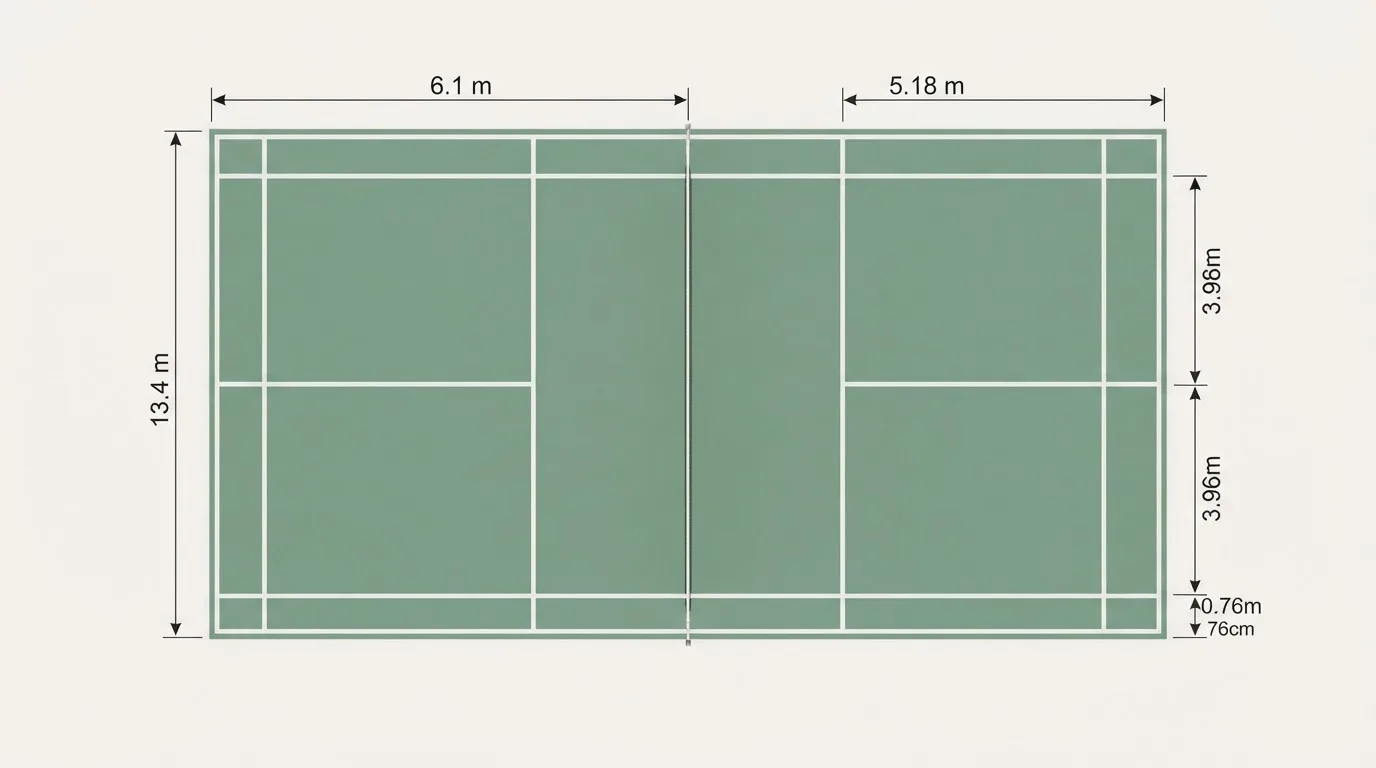
The court dimensions matter because they set the shape of the rallies and the realistic margins. A badminton court is 13.4 m long, 6.1 m wide for doubles and 5.18 m wide for singles; the net is 1.55 m at the edges and 1.524 m at the centre. That is half a tennis court, and the rallies end much faster. The bookmaker’s pricing model has to account for the fact that a long rally in men’s singles produces one point every 30–60 seconds at the top of the game, and a service break is not a thing — service changes sides each point, so a player can run a service streak without “breaking” the opponent. There is no Rule 4 equivalent. There is no “rain stops play” risk. There is a fitness risk, and the books price it: a five-set-equivalent in badminton is three games at the long end, and a player who wins the first game 21–12 is not always in control of the match.
The five disciplines and the rally-point scoring system are the ruleset a bookmaker’s market-makers work from. Any book offering “set betting” or “correct score” markets on badminton is, in effect, asking the punter to predict the path of three independent 21-point games; “game handicap” is the same as set handicap in tennis, with a half-game line and a full-game-and-a-half line. “Race to 10” and “total points” sit on top of the same model, with the same volatility.
How a UK Bookmaker’s Margin on Badminton Looks
The margin a bookmaker takes is what the prices leave on the table after all outcomes of a market are added up. For a market with two outcomes priced at decimal odds of 1.90 against 1.90, the implied probabilities are 1 ÷ 1.90 = 52.63% on each side, summing to 105.26%. The overround is the gap between that sum and 100%, which is 5.26%; the margin is the overround, expressed as a percentage of turnover — 5.26% in this case. A punter betting one unit on each side of a two-way market at 1.90/1.90 loses 5.26% of total stake to the book, on average, before any other rule is applied.
That 1.90/1.90 example is illustrative, not a quoted price, and a real badminton price sits somewhere else. The margin on a men’s singles World Tour match winner is, on the larger books, in the same low single digits to mid single digits as a top-tier tennis match — the books that have invested in BWF data price tighter; the books that have not price wider. A punter looking at a women’s doubles Super 300 match on a smaller bookmaker will often see a margin two to three points higher than the equivalent men’s singles, because fewer bets are taken and the book prices the book wider to manage its risk.
The practical consequence: on a market at a 5% margin, every £100 of matched betting at the published prices returns, on average, £95 to whichever side lands. On a market at an 8% margin, the same £100 returns £92. The 3% gap is the price a book charges for less liquid markets, less data, and fewer punters willing to bet. The gap is also where the welcome offers and price boosts are pitched: the punter is being asked to take a price that has, in many cases, an 8–10% margin baked in, and to back it with a free bet whose true value is a fraction of its face.
Top 10 UK-Licensed Bookmakers for Badminton in 2026
The ten brands below are the operators reviewed on this page, in the order the ranking takes them. Each holds a Gambling Commission remote licence and runs an in-house badminton menu to some depth. The comparison table at the head of this section shows the licence and the headline market coverage; the operator blocks beneath it run the deeper view.
| Brand | Gambling Commission remote licence number and licence holder | What the operator’s own terms state on the key’s subject |
|---|---|---|
| Ladbrokes | 054743-R-330863-014, LC International Limited | Deep in-play menu across major sports; badminton listed under racquet sports with match winner, set betting and game handicap on World Tour events. |
| Bet Ahoy | 100094-R-341742-003, Bet Ahoy Ltd | Newer brand; badminton covered as part of a wider racquet sports book, with match winner and set betting on the BWF Tour. |
| Fitzwilliam Sports | 048760-R-335434-009, SBKI Limited | Dublin-based, capped membership; badminton offered selectively on the bigger BWF events, with the higher-stakes welcome terms framing the book. |
| London Bet | 066162-R-340278-004, Thistle Bet Limited | Sports app combining in-play on major sports with casino; badminton sits in a smaller menu of racquet sports with the headline markets. |
| Unibet | 045322-R-324275-019, Platinum Gaming Limited, Gibraltar | Long-established international sports book (operating since 1999); BWF Tour covered with match winner, set betting, game handicap and a deeper in-play card. |
| Smarkets | 039173-R-319366-011, Smarkets (Malta) Limited | Betting exchange; badminton priced as a back-and-lay market with the books at the back, set by user liquidity, which tends to thin out on this sport. |
| Fafabet | 057385-R-333191-006, Taichi Tech Limited | UK-facing sports book with horse racing depth (Best Odds Guaranteed on UK and Irish racing from 9am); badminton carried on the BWF Tour with the headline markets. |
| bet365 | 055148-R-331498-002, Hillside (UK Sports) ENC | The largest in-play book in the UK by volume; the deepest badminton card on this list, with in-play, Bet Builder+ on selected events, Super Boosts and live streaming on major BWF matches. |
| Hollywoodbets | 053028-R-330019-013, Hollywoodbets International UK Limited | South African heritage book now serving the UK; BWF Tour covered with match winner and set betting; the welcome offer targets accumulators. |
| Kalooki Sportsbook | 057730-R-333396-005, Kalooki Sportsbook Limited | Small UK sports book; badminton listed as a racquet sport with match winner and set betting on the BWF Tour. |
Ladbrokes
Ladbrokes runs a deep in-play book on the major racquet sports, and badminton is part of that. Match winner, set betting and game handicap are available on World Tour singles and doubles; the menu thins fast below the Super 500 level. The Ladbrokes Sports Betting App, published by Entain Operations Limited, holds a 4.66 rating from 101,255 ratings in the GB App Store at the time of writing, which is a working app rather than a niche one. The wider product sits on the Coral/Ladbrokes group licence, with several brands running under one Gambling Commission account.
The cost of the menu is the menu itself: a deeper book on a thin sport lets the bookmaker price each line tighter, and tighter prices are a real saving to the punter. The cost of the menu at a thin end of a thin sport is that a lot of BWF Super 300 round-of-32 matches simply do not appear, and a punter wanting that match moves on.
Bet Ahoy
Bet Ahoy is a newer UK-facing bookmaker, with a welcome framed as a £10 sports bet and a £5 acca at the £10 trigger. The card is part of a wider sports book rather than a badminton specialist. Match winner and set betting on the BWF Tour is the realistic ceiling, and the in-play card on badminton is short.
The brand is small and the price is the price; the cost here is the welcome offer, which is a real bonus at a low staking threshold. Whether the offer is worth taking depends on the punter’s interest in the acca leg, which is the harder of the two to clear at value. A bettor who would have placed a £10 singles bet on a BWF match anyway takes the £5 acca as a small upside; a bettor who only places the bet to clear the acca is taking a worse line than the open market offers.
Fitzwilliam Sports
Fitzwilliam Sports describes itself as a Dublin bookmaker with capped membership. The welcome is a “High Stakes Welcome” subject to compliance criteria, and the brand’s own home page names timeouts, deposit limits, instant deposits, fast withdrawals, and links to GambleAware, GamStop and Gamblers Anonymous. The badminton card is selective — the bigger BWF events rather than the full tour — and the membership cap is a deliberate choice to manage book risk on thin markets.
A capped-membership book is a higher-stakes environment with a different cost profile. The lines on the matches the book carries are tighter than the smaller brands, and the welcome offer is framed for the higher-stake bettor; a £10 recreational punter is below the level the book is aiming at, and the welcome’s compliance criteria can exclude that punter before any bet is placed.
London Bet
London Bet’s app combines sports betting on football, tennis, horse racing, greyhounds, darts, golf, cricket, NFL, NBA, MLB and snooker with Pragmatic Play casino slots and live in-play betting. Badminton is in a smaller menu of racquet sports, with the headline markets on the BWF Tour. The wider product is a casino app with a sports book, and the cost of that is the cost of any sports book on a casino platform: a thin card on a thin sport, with the lines wider than a specialist.
The right reader for London Bet is a punter who wants one app for casino and sports, with badminton as an occasional interest rather than a focus. The wrong reader is a punter who wants the deepest badminton card in the UK, which London Bet does not have.
Unibet
Unibet states it has operated since 1999, and its UK site runs under Platinum Gaming Limited, Gibraltar, on Gambling Commission account 45322. The sports welcome is “Get £40 in Free Bets when you bet £20”: a deposit and sports bet of £20 or more at minimum odds of 2.0 (1/1), with free bets expiring within 7 days of issue, for new GB customers using a debit card or instant bank transfer. The BWF Tour is covered with match winner, set betting, game handicap and a deeper in-play card than most brands on this list.
The cost of the welcome is the 7-day expiry on the free bets and the minimum price of 2.0 on the qualifying bet. A £20 qualifying bet at 2.0 is, in the punter’s terms, a “50/50 shot” — a 50% chance of winning at evens, which is a real but not generous requirement. The 7-day expiry on a £40 free-bet bundle is the part a punter should plan around: the free bets are only worth taking on a market and at a price the punter would have backed anyway, in the seven days after they land.
Smarkets
Smarkets is a betting exchange rather than a traditional bookmaker, licensed as a remote betting intermediary. UK open-bank-transfer deposits are instant from £10 up to £10,000, and withdrawals are processed within 6 hours from £10 up to £100,000; UK debit-card deposits are instant from £10 up to £15,000. The badminton prices on the exchange are back-and-lay markets set by user liquidity, and that liquidity is thin on a sport this small in the UK. A punter looking at a BWF match on the exchange will often find a back price and a lay price several ticks apart, with the gap the market’s own margin.
The cost of an exchange is the gap between back and lay, which is wider on badminton than on football or horse racing. The benefit is that the gap, on a heavily-backed match, can be smaller than the margin on a small bookmaker, and the exchange’s commission is a flat percentage of net winnings rather than a margin baked into the price. The right reader for the exchange is a punter who understands back and lay, who is happy to wait for the price to come in, and who treats liquidity as the constraint.
Fafabet
Fafabet’s headline product is Best Odds Guaranteed on UK and Irish horse racing win and each-way bets from 9am on race days: if the starting price is bigger than the original price, Fafabet pays the bigger odds. The badminton book is part of the wider racquet sports offering, with the BWF Tour match winner and set betting carried on the bigger events.
The cost of Fafabet is that the brand is horse-racing-first and badminton is a secondary sport; the menu reflects that. A punter whose main interest is the BWF Tour will find the menu shorter than on a tennis-first book and the in-play card thinner. A punter whose main interest is horse racing and who wants a BWF bet on a Saturday will find both at the same place.
bet365
bet365 is the official global betting partner of the UEFA Champions League, and its app is described in the GB App Store listing as the most downloaded sports betting app in the UK. The badminton card is the deepest on this list: in-play betting and live streaming of events worldwide, Bet Builder+ (combining markets from one event into a single bet, available pre-match and in-play), Super Boosts, Winnings Boosts on Bet Builders and selected singles, daily Bet Boosts, and the same Match Live and Bet Track tools the brand runs on football. Hillside (UK Sports) ENC is the licence holder.
The cost of the deepest card is the brand’s promotional cadence: Super Boosts and Bet Boosts are daily, and a punter who treats them as “free” value is paying for them in margin on the underlying market. A boosted price is still a price; the boost is a marketing number, and the value depends on the unboosted price beside it. The right reader for bet365 is a punter who wants the deepest badminton card in the UK and is willing to read the small print on every boost. The wrong reader is a punter who treats a Super Boost as a free lunch.
Hollywoodbets
Hollywoodbets is a South African heritage bookmaker now serving the UK, with the sports welcome offer framed for accumulators: new players who deposit £10 or more by card get their stake back as a free bet of up to £30 on their first qualifying losing accumulator — stake £10+, 3+ legs, odds of 4/1 or greater, settled within 7 days; one free bet per customer. The BWF Tour is covered with match winner and set betting.
The cost of the welcome is the 4/1 minimum and the three-leg minimum on the qualifying accumulator. A £10 treble at 4/1 is, on average, a long shot; a treble at 4/1 on badminton is a long shot with three independent long shots, and the punter who clears the welcome at value is the punter who would have placed that treble anyway. The refund as a free bet, capped at £30, is the upside on a losing qualifier; the value of a free bet whose stake is not returned is, in the same units, lower than the value of a cash refund.
Kalooki Sportsbook
Kalooki Sportsbook is operated by Kalooki Sports Book Ltd (company number 12938274), licensed by the Gambling Commission under account 57730, and is a GAMSTOP member. The product is a small UK sports book, with badminton listed as a racquet sport and match winner and set betting on the BWF Tour.
The cost of a small book is a small menu and a wider margin on the matches it does carry. The benefit is a brand-sized welcome and a thinner, simpler product. The right reader is a punter who wants a small, British-facing book on the BWF Tour, with the standard safer-gambling tools.
The Legal Frame: Gambling Commission, LCCP and the Offer Rules
Every operator reviewed above holds a Gambling Commission remote licence for Great Britain, and that licence is the regulatory frame the page describes. The Commission is the non-departmental public body sponsored by the Department for Culture, Media and Sport, and it licenses the whole commercial market under the Gambling Act 2005. Great Britain is the relevant jurisdiction — England, Scotland and Wales; Northern Ireland is outside the Act and has its own older law. Since the Gambling (Licensing and Advertising) Act 2014 an operator whose remote facilities are used in Great Britain needs a Commission licence wherever it is based, on sections 33 and 36 of the 2005 Act as amended; a Curaçao, Maltese or Gibraltar licence is not a substitute for serving British customers. Platinum Gaming Limited, the licence holder behind Unibet’s UK site, is Gibraltar-incorporated; the Commission licence is what makes that legal in Great Britain, not the Gibraltar licence.
There is no statutory list of permitted sports or markets. A bookmaker holds a licence for a category — remote general betting standard (real events), remote general betting standard (virtual events), remote general betting limited, remote pool betting, or remote betting intermediary for exchanges — and offers markets under its own rules and the LCCP. Badminton sits under “remote general betting standard (real events)”; the same licence covers football, tennis, horse racing and every other real-world event. Esports are treated like any other event. Virtual events are a separate licence category. Politics, TV shows and novelty markets are offered by GB bookmakers and no statutory prohibition was found. In-play betting is offered by GB bookmakers under the operator’s licence conditions and customer-protection duties; it is not legally “unrestricted” as a category, and the controls are operator-side.
The Commission’s public register is the whole test of whether a brand holds a licence. The register can be searched by business name, trading name, domain or account number. The numbers in the table above are the account numbers from that register, and the licence holders are the corporate names that hold them. A licence number on a brand’s own page is a starting point, not a confirmation; the register is the confirmation. Several brands can run under one licensee — Ladbrokes and Coral on the LC International Limited licence, Paddy Power and Betfair on the Flutter licence — and they are not independent operators for regulatory purposes. The customer uses a brand name and the register matches the corporate holder behind it.
The minimum age is 18, and name, address and date of birth are verified before a customer can deposit or gamble, in force since 7 May 2019; the verification covers free bets and bonuses, which is why a welcome offer at a licensed book is never anonymous. A financial vulnerability check applies under LCCP condition 3.4.4, in force since 30 August 2024, when a customer’s deposits minus withdrawals exceed £150 in a rolling 30 days — since 28 February 2025 — and is a public-record check (for example bankruptcy or county court judgments), not an income or credit-reference check. Financial risk assessments, the “affordability checks” of the press, are announced in a staged plan in a Commission article of 7 July 2026, with no start date; the page describes them as “announced, staged, no start date”, not as in force.
There is no state-set deposit or loss ceiling for betting. Limits are the customer’s choice, on the operator’s interface. Operators set their own maximum stakes and may restrict customers; the LCCP does not impose a stake cap.
What a welcome offer is allowed to look like in 2026
Promotion rules in force since 19 January 2026 cap wagering requirements on bonuses at 10x: a £10 bonus at 50x needs £500 of bets, and under the cap no more than £100. Mixed-product promotions — an offer that requires gambling on two or more product types, such as “bet on football to get free spins” — are banned. Whether the cap applies to free bets with no wagering condition, and any cap on the money value of a bonus, are not established. A free bet whose stake is not paid back on a win is the kind of offer this page reviews; a “risk-free” bet refunded as a free bet is a free bet, not a refund in money, and the audit does not restyle it.
Tax: what the punter pays, what the operator pays
The punter pays no tax on betting winnings in Great Britain. The operator pays General Betting Duty on its gross profits, currently 15%; from 1 April 2027 a new remote betting rate of 25% applies within it, while remote bets on UK horse racing, self-service betting terminal bets, pool betting and in-person betting stay at 15%. Until 1 April 2027 the remote rate stays at 15%. Whether operators pass duty on through odds is not established. The Commission’s statutory levy is a separate charge, not a tax. Spread betting has its own rates — 3% financial, 10% other — and is regulated by the Financial Conduct Authority rather than the Commission on the financial side.
Safer Gambling: GAMSTOP, the Vulnerability Check and the Helpline
GAMSTOP is the national multi-operator online self-exclusion scheme and a mandatory licence condition for online operators since 31 March 2020. Periods are six months, one year, five years, or five years with auto-renewal; after the minimum period the exclusion stays in place for a further seven years unless the customer asks GAMSTOP to remove it. GAMSTOP covers online sites and apps; betting shops use a separate service. Every GB-licensed online operator takes part, and the ten brands above are all GAMSTOP members by licence condition.
The safer-gambling tools a licensed bookmaker has to offer are: a deposit limit (the operator must offer a gross deposit limit on a fixed time frame; the first changes applied on 31 October 2025, a second phase was postponed to 30 September 2026, and whether it is live is not established), timeouts, self-exclusion, reality checks, and access to the safer-gambling organisations: GamCare (the National Gambling Helpline), GambleAware, NHS gambling clinics, and Gamblers Anonymous. Credit cards are banned for gambling in Great Britain, in force since 14 April 2020 under LCCP condition 6.1.2, including credit-card-funded payments through an e-wallet. Debit cards and bank-based payments are not covered by that ban. There is no state list of permitted payment methods; the page describes payments qualitatively and only from each operator’s terms.
The financial vulnerability check is the practical version of the safer-gambling regime for a higher-spend punter. The £150 deposits-minus-withdrawals rolling 30-day threshold is the trigger, and the check is a public-record check rather than an income check. The check is not optional at the licensed book; a punter whose deposits minus withdrawals clear the threshold is asked the questions, and an operator that does not ask is in breach of its licence.
Where the punter gets help
GamCare runs the National Gambling Helpline; the NHS runs gambling clinics; GambleAware funds treatment and education; Gamblers Anonymous runs peer-support meetings. The brand pages link to these organisations in their safer-gambling sections. A punter who is concerned about their own play or someone else’s should reach one of these bodies directly rather than relying on the brand’s own tools as the only safeguard.
Welcome Offers on Badminton: What the Bonus Is Worth
A welcome offer on a UK-licensed book is a real value at the right price and a poor value at the wrong one, and the same offer can be either depending on the market the punter backs with it. The two shapes a badminton punter meets in 2026 are the free bet (a stake provided by the book, paid back only on a win) and the stake-back free bet (a refund of the punter’s own stake on a losing qualifier, paid as a free bet, usually with a cap and a minimum-price condition).
The free bet on its own is worth, in the same units as its face, the free-bet amount multiplied by the gap between the offered price and 1, divided by the offered price, and weighted by the payout share of the market. At 1.90 (a price with a 5.26% margin, payout share 94.74%), a £10 free bet is worth £10 × (1.90 − 1) ÷ 1.90 × 0.9474 = £4.49 on average. That is the average value across many such bets; a single free bet on a winning outcome pays £10 × (1.90 − 1) = £9 in profit, while a losing outcome pays nothing, and the average across both is £4.49 once the margin is accounted for. A free bet at 4.00 on the same market is worth £10 × (4.00 − 1) ÷ 4.00 × 0.9474 = £7.11 on average; the higher the price, the more of the free-bet face is paid back, because more of the bet’s return is winnings rather than the stake.
The stake-back free bet — Hollywoodbets’ offer is the shape on this list — refunds the punter’s stake on a losing qualifier as a free bet, capped at £30, on a 3+ leg accumulator at 4/1 or greater, settled within 7 days. The qualifier is, in expected-value terms, a treble at minimum odds of 5.00 (4/1 in fractional) — a treble whose three legs each carry their own bookmaker’s margin. The expected loss on the qualifying bet, taking a typical margin of 6% on each leg, is the £10 stake times 1 minus the payout share of (1 − 0.06) cubed, or 16.3% of stake lost on average before the refund. The free bet that comes back is worth the average free-bet value at whatever price the punter places it, and that price is at the punter’s choice within the 7-day expiry. A punter who places the refund at 5.00 on a market with a 6% margin recovers, on average, £30 × (5.00 − 1) ÷ 5.00 × 0.94 = £22.56; the offer as a whole is worth the refund’s expected value minus the expected loss on the qualifier, which lands around £9 on average before the qualifier’s chance of winning is even counted.
The marketing word on a free bet is “free”. The free bet is a stake at no cash cost to the punter, and that part is real. What is not “free” is the price the book offers on the bet, the margin baked into that price, the 7-day expiry that pushes the punter onto a market they would not otherwise have backed, and the cap that bounds the upside. A free bet is, in plain terms, a stake the punter uses on a price the book has set, and the price is where the value lives or dies.
The minimum price: why 2.0 matters
A “Bet £20 at minimum odds of 2.0 to get £40 in free bets” welcome, in the shape Unibet runs, is a real offer at a real cost. The minimum odds of 2.0 (1/1 in fractional, a 50% implied chance) is the qualifying threshold, and a punter who places the £20 at a price below 2.0 does not qualify. The minimum is the price the book requires the punter to back, and it sets a floor on the kind of bet the welcome can be cleared with: an “evens” shot at 2.0 is a real but not generous requirement, and a punter backing a 1.50 shot (an “odds-on” favourite) does not qualify.
The deadline: 7 days is a working week
The 7-day expiry on the free bets at Unibet, on the Hollywoodbets stake-back, and on similar offers, is a working week, and it is the practical constraint on the offer. A punter who has three ongoing BWF bets in the next 7 days has a real chance of using the free bets at a price they would have taken anyway. A punter who has no such bets has to find a market, and the market they find in a hurry is, on average, a worse one than the market they would have found with a week to wait.
In-Play Betting and Cash Out on Badminton
The five live-betting angles on badminton are: in-play match winner, in-play game winner, in-play race to 10, in-play next-point (a minority of books), and the cash-out function. bet365 is the most fully-featured book on this list for in-play badminton, with in-play betting and live streaming of events worldwide, Match Live and Bet Track; other books carry in-play match winner and in-play game winner on the BWF Tour and stop there.
In-play on badminton has a particular shape because of the rally-point scoring rule. The bookmaker’s in-play price on a match is updated after every point, and the swing on a long game is wider than on a sport with fewer scores per minute. A bookmaker that updates its prices every 5–10 seconds during a rally is offering a different product from a bookmaker that updates every 30–60 seconds, and the better in-play book is the one whose prices reflect the latest score with the smallest delay. Cash out is a separate function, on top of the live price: it lets the punter lock in a position at the in-play price the book is offering, and the book holds a margin on the cash-out price in the same way it holds a margin on the in-play price.
The cost of in-play on badminton is the bookmaker’s data feed. The BWF runs the official scoring, and the bookmaker has to license a feed that updates with point-by-point scores; the books with the deepest BWF data are the books with the tightest in-play prices. The cost of the in-play product is the price of the feed, which is built into the margin.
Reading Badminton Form: A Strategy Frame That Does Not Promise Wins
A betting strategy on badminton is the same shape as a betting strategy on any other sport: a model of the probability of each outcome, priced against the bookmaker’s price, sized in stakes that the punter can sustain through losing runs. The model for badminton relies on head-to-head history, recent form on the BWF Tour, court surface (the BWF Tour uses a hard court with a synthetic mat, with venue altitude and humidity affecting flight), injury, and ranking. The model’s output is a probability for each outcome; the punter’s bet is the model’s probability × the offered price > 1, and the punter’s stake is the bankroll × the model’s edge, sized to survive a normal losing run.
The page does not promise wins. The model is a way to compare a bookmaker’s price to the punter’s own probability; if the punter’s probability is higher than the implied probability, the bet has positive expected value. The book’s probability is wrong more often than the punter’s in absolute terms — the book is a market-maker across many events, the punter is a specialist on one — but the book has the data the punter does not, and the price is the best estimate on offer. The punter’s edge is, in practice, a small number; the bankroll management is the larger part of the work.
Stats software: the legitimate tools
The legitimate stats tools for badminton betting are: the BWF’s own tournament pages (draw, results, head-to-head), the BWF World Rankings, BWF World Tour season standings, third-party data feeds that license the BWF data, and the bookmakers’ own statistics pages on the matches they offer. There is no such thing as a software product that “predicts” badminton outcomes in a way the punter does not have to do themselves; the model is the punter’s, and the data is the BWF’s, and the rest is the punter’s reading of both.
The Markets: Match Winner, Set Betting, Handicap and the Rest
The markets a UK-licensed book offers on a BWF World Tour singles match, in order of depth, are: match winner (the most liquid, the tightest margin), game handicap (a half-game line or a game-and-a-half line, the second most liquid), set betting (the correct score, 2-0 or 2-1), total games (over/under 2.5), race to 10, total points, and a small number of player-props on the bigger matches. The deeper markets — total points, race to 10, player props — exist on the larger books and dry up fast below the BWF Super 500 level.
Set betting on badminton is the equivalent of correct score in football or set betting in tennis: the punter names the exact scoreline in games, 2-0 or 2-1, in a best-of-three match. The margin on set betting is wider than on match winner because the book is pricing four discrete outcomes rather than two. Race to 10 is the equivalent of “first to N points” in any rally-point sport, and the margin sits between match winner and set betting.
The accumulator
The accumulator on badminton is the same shape as the accumulator on any other sport: the punter backs several selections, the odds multiply, the stake is one unit, and the bet pays only if every leg wins. A 3-leg badminton acca at 2.0/2.0/2.0 prices at 8.00, and the combined margin is roughly 1.05 cubed minus 1, or 15.8% — a 15.8% overround on the acca price, in a market where the underlying legs each had a 5% overround individually. The acca magnifies the margin, and the welcome offers at Hollywoodbets, Bet Ahoy and similar books are aimed at the acca punter.
A bettor who backs a 3-leg acca at 4/1 or greater, the Hollywoodbets qualifying threshold, is backing an 8.00/1 treble (decimal 9.00) at minimum — a price the punter takes in exchange for three independent chances of losing the stake. The cost of the acca is the compounded margin; the cost of the stake-back offer is the qualifier’s expected loss.
Same-game multi / bet builder
A bet builder is a single bet that combines several markets from one match — match winner plus total games over 2.5, for example — into a single price, paid only if all legs win. The same-game multi magnifies the margin in the same way the acca does, and the legs are not independent within the match. bet365’s Bet Builder+ is the deepest such product on this list, and the same logic applies: the price is the multiplied price, the margin is the compounded margin, and the punter’s edge is the gap between the punter’s probability and the bookmaker’s.
The Maths: Reading the Odds, the Return and the Margin
A bet at decimal odds of a returns, on a win, the stake × a. The net profit, on a win, is the stake × (a − 1); the stake is paid back in the return. A £10 bet at 2.50 returns £25 on a win: £10 of stake plus £15 of profit. A £10 bet at 1.50 returns £15: £10 stake plus £5 profit. A £10 bet at 5.00 returns £50: £10 stake plus £40 profit.
The implied probability of a price a, before the margin is accounted for, is 1 ÷ a. At 2.50 the implied probability is 40%; at 1.50 it is 66.7%; at 5.00 it is 20%. The sum of implied probabilities across all outcomes of a market is the overround. For a two-way market at 1.90/1.90 the sum is 105.26%; the overround is 5.26%; the margin is 5.26% of turnover. For a three-way market (1, X, 2) at 2.10/3.40/3.40 the sum is 47.62% + 29.41% + 29.41% = 106.44%; the margin is 6.44% of turnover.
Fractional odds, the British form (5/1, 11/4, evens), convert to decimal by a/b + 1. Five-to-one is 5 ÷ 1 + 1 = 6.00; eleven-to-four is 11 ÷ 4 + 1 = 3.75; evens is 1/1 = 2.00. “Odds-on” (shorter than evens) is a price below 2.00 decimal; “odds-against” (longer than evens) is a price above 2.00. The starting price (SP) is the price the book settles at from the on-course market in horse racing; the Best Odds Guaranteed product pays the bigger of the price the punter took and the SP, when the SP is bigger. Neither concept is native to badminton, where the price is the price the book sets.
The expected loss on a market at margin m is m × total stake, on average, across all outcomes. A punter who bets £100 across the outcomes of a market at a 5% margin loses, on average, £5 to the book. A punter who places a £10 accumulator at 8.00 across three legs of a 5% market loses, on average, £10 × 15.8% = £1.58, on top of which the punter’s chance of winning the accumulator is the product of the three leg-chances, which is much smaller than any one leg’s chance.
Cost: What the Page Has Established
The page’s subject is cost, and the cost on a badminton bet at a UK-licensed book is the sum of three things: the margin in the price, the friction in the welcome offer (if the punter takes one), and the operational cost of moving money in and out. The margin in the price is the largest of the three on a small-stake recreational bet, and the friction in the welcome offer is the largest of the three when a punter clears a £20-at-2.0-to-get-£40 offer without a real BWF bet in the seven days. The operational cost of moving money is small on a UK debit card at Smarkets (instant deposit up to £15,000; withdrawal within 6 hours up to £100,000) and a percentage point or two larger on the smaller books.
A punter with a £20 recreational budget on a Saturday’s BWF card is paying, on the larger books, around 5% in margin, no friction if they skip the welcome, and a small operational cost on the deposit. A punter clearing a Unibet welcome at the minimum qualifying price is paying the margin on the £20 qualifier (around £1 in expected loss), the 7-day expiry on the free bets (which forces the punter onto a market they might not have taken), and the margin on the free-bet placement (£40 × 4.49% on average across many such bets at 1.90, in the formula given earlier, which is £4.49 of expected value before the 7-day expiry constraint). The welcome is worth taking on the offer’s terms; the welcome is not worth chasing for its own sake.
Frequently Asked Questions
How does a punter place a bet on badminton?
A punter opens an account with a UK-licensed bookmaker, verifies their name, address and date of birth before the first deposit, deposits by debit card or bank transfer (credit cards are banned for gambling in Great Britain), and selects a BWF World Tour or other event under the racquet sports tab. The bet types on a singles match are match winner, set betting, game handicap, and the deeper markets on the larger books. The bet settles at the price taken, and the return is the stake multiplied by the decimal odds on a win.
How can a bookmaker’s Gambling Commission licence be checked?
The Commission’s public register can be searched by business name, trading name, domain or account number; the account numbers in the table above are the entries on that register. A licence on a brand’s own page is a starting point; the register is the confirmation. The licence categories — remote general betting standard (real events), remote betting intermediary, and so on — are listed against the licence and the categories tell the punter which products the book is licensed to offer.
How is the return on a bet worked out from the stake and the odds?
The return on a win is the stake multiplied by the decimal odds. A £10 bet at 2.50 returns £25: £10 of stake plus £15 of profit. The net profit, on a win, is the stake × (odds − 1); the stake is paid back as part of the return. A combination bet’s odds are the product of the leg odds, and a £10 accumulator at 2.0/2.0/2.0 returns £80 on a win: £10 × 8.00.
What is the bookmaker’s margin and how can it be seen in the odds?
The margin is the share of every pound bet on a market that the book keeps, on average, across all outcomes. It is the gap between the sum of the implied probabilities and 100%. On a two-way market at 1.90/1.90 the implied probabilities are 52.63% and 52.63%, summing to 105.26%; the margin is 5.26% of turnover. A 5% margin is a typical price on a deeper BWF World Tour match; a 7–8% margin is more typical on a less-followed match on a smaller book. The market at the tighter margin is the cheaper market to bet on, before any other rule is applied.
How do fractional odds such as 5/1 convert to decimal odds such as 6.00?
Fractional odds a/b convert to decimal by a ÷ b + 1. Five-to-one is 5 ÷ 1 + 1 = 6.00; eleven-to-four is 11 ÷ 4 + 1 = 3.75; evens is 1/1 = 2.00. The British bookmaker’s racecard writes prices in fractional form, and the same price on the same horse on an exchange is in decimal form; the two forms are the same price.
Which safer-gambling tools does a licensed bookmaker have to offer?
The licensed bookmaker has to offer a deposit limit on a fixed time frame, timeouts, self-exclusion, reality checks, and links to GamCare, GambleAware and Gamblers Anonymous. The book is a GAMSTOP member by licence condition, and the punter can register with GAMSTOP to be barred across all participating operators for six months, one year, five years, or five years with auto-renewal. A financial vulnerability check applies when a customer’s deposits minus withdrawals exceed £150 in a rolling 30 days, and is a public-record check rather than an income or credit-reference check.
Tennis, darts & cue sports – Matchedbettinguk.com
Content created by the «Matchedbettinguk.com» team
