
Greyhound racing betting odds — what the price is really telling you
 Available in US
A greyhound race settles in twenty-five seconds. The betting market around it does not. Every price a licensed bookmaker quotes carries a margin baked into both sides, and that margin is what the dog leaves behind whether the trap opens cleanly or the favourite trips at the first bend. The picture on a betting screen — 5/2 the dog in trap three, 11/4 the one in trap one, 3/1 the outsider — is a single decision: back the runner, take the price, accept the cut the book has already taken from the picture. What follows is what those odds are made of, what the margin costs across a meeting, and which GB-licensed bookmakers carry greyhound markets worth a serious punter’s time.

*Current as of October 30, 2026 against the Gambling Commission’s public register and each operator’s own published terms.*
Reading the price on a greyhound race
A greyhound market is, mechanically, a two-sided book. Two runners, two outcomes, two prices. A bookmaker quotes a price for each runner, and the gap between what the two prices would return in a perfectly fair market and what they actually return is the margin. That margin is the same thing whether it is dressed up as a bookmaker’s take, an overround, or a payout share — the slice of every pound staked the book keeps, regardless of the result.
The simplest greyhound market to read against is a head-to-head or a single two-runner match bet. Take a price of 5/2 (3.50 in decimal) on dog A and 11/4 (3.75) on dog B. If those prices were honest in the sense that every pound staked could be returned to the winning side, the implied probabilities would sum to one: 1/3.50 plus 1/3.75 equals 0.286 plus 0.267 equals 0.552, or 55.2 per cent. The remaining 44.8 per cent of every pound is the bookmaker’s margin. A punt on either dog pays out as if the race were already 44.8 per cent settled in the book’s favour before the traps spring.
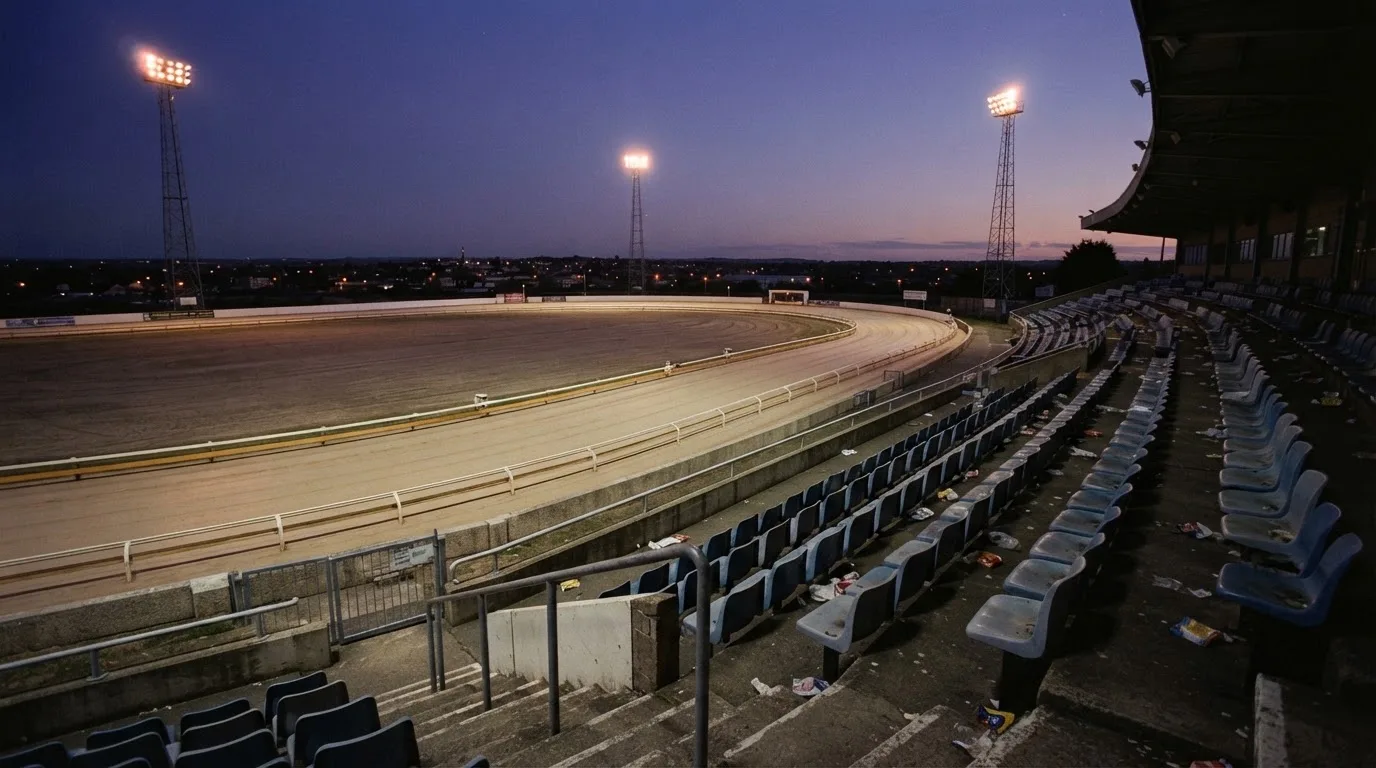
On a six-runner race the maths scales. Eight runners, a full card at Belle Vue, twenty races in an evening — the margin sits inside every quoted line, and the only thing that changes race to race is how visible the cut is. A bookmaker quoting 5/2 the favourite on a six-runner card is making the favourite look shorter than the public form suggests, and the outsider’s price look longer than the form warrants, by exactly the percentage the margin eats.
The calculation is worth keeping in mind the next time a price on the tote catches the eye. If a tote shows true odds — that is, the dividend paid out in proportion to the pool, with the takeout stripped out by the operator — the bookmaker’s fixed-odds line cannot be more generous on the same selection. It can only be less generous, by the size of the margin it carries. A precise payout share and a precise margin add up to 100 per cent, and they have to: that is what one market seen from two sides looks like, and the two numbers reconcile by construction.
Single, each-way, forecast and tricast: how settling changes
The win market is the simplest greyhound bet. Back the dog, take the price, the dog wins, the book pays the return. The bet costs the stake once.

An each-way bet is two bets of equal stake on the same dog — one on the win market, one on the place market. The stake doubles. The place terms are set by the bookmaker and depend on the number of runners: in greyhound racing a typical place fraction is a quarter of the win odds on the first two places in a race of five or more runners, and a fifth on the first three places in a race of eight or more. Each-way punters should read the place terms on the betting slip before clicking. On a 5/2 shot in a six-runner race at one-quarter the odds, the place leg returns at roughly 11/8 (1.375 in decimal), which is enough to give a small profit on the whole bet when the dog finishes second and a clear profit when it wins, but a small net loss if it places only because the win leg lost half the stake.
A forecast (straight) names the first two dogs in the correct order. A tricast names the first three. Forecast and tricast dividends on the tote can be very large when the result is unfancied, because the bet multiplies the per-combination stake by the dividend returned. The fixed-odds version, where a book quotes a price on a forecast or tricast combination, is harder for the punter to price than a single because the book’s margin is split between more outcomes than a win market — six runners produce thirty forecast permutations and 120 tricast permutations, and the per-combination margin compounds across them. Where a forecast market is offered at fixed odds rather than tote dividends, the prudent move is to compare the fixed-odds price against the equivalent forecast pool on the same race, and pick whichever side returns the more to the pound staked.
Combination bets and what they cost
A combination bet — a double, a treble, an accumulator (“acca”) — pays the product of the leg prices when every leg wins. Two legs at 3.00 and 4.00 return twelve times the stake if both win. Three legs at 3.00, 4.00 and 5.00 return sixty. The arithmetic is straightforward. The arithmetic that is not straightforward is the margin.
A combination bet’s effective margin is not the sum of its legs’ margins. Each leg carries its own margin, and the legs multiply into a single price whose implied probability is the product of the legs’ implied probabilities — including the margin. Two legs at 3.00 and 4.00 are each roughly 5 per cent overround in their own market. Combined, the implied probability of the double is 1/3.00 × 1/4.00, which is around 8.3 per cent, and the price the book quotes reflects a margin bigger than either leg’s margin in isolation. Three legs push it further. A four-fold acca at modest per-leg margins can carry a combined margin well into double digits, and that combined margin is sitting on the punt regardless of how confident each leg looks.
The way to read a combination price against a margin is to invert the price to an implied probability, then invert each leg separately, and compare. The difference between the two is the compounded margin. In practice, the punter who wants a combination bet pays a premium for the privilege — and on a bookmaker with thin margins on singles, the acca can still come out as the worst-priced bet on the card.
Full cover bets: what the stake actually costs
Full cover bets — Trixie, Patent, Lucky 15, Yankee, Heinz, Goliath — package combinations into a fixed bundle. A Lucky 15 is fifteen bets across four selections: four singles, six doubles, four trebles and a four-fold accumulator. A Yankee is the same minus the singles. A Heinz is fifty-seven bets across six selections. A Goliath is two hundred and forty-seven bets across eight. The total stake is the unit stake multiplied by the number of bets, so a 50p Goliath costs £123.50 before any selection runs.
These bets are pitched as giving the punter “something to cheer for” early — a single leg winning returns something, even when the rest of the card blows up. The trade-off is structural. The singles inside a Lucky 15 are priced at the same margin as singles on the standalone markets. The doubles, trebles and accumulator inside it are priced at the compounded margin described above. The bookmaker’s edge on the package is therefore a weighted average of single and combined margins, with the singles softening it slightly. A purist who wants only combination exposure buys a straight accumulator and skips the singles. A punter who wants a sweat pays the package price.
The honest read on full cover bets is that they make sense when the punter actually wants singles, doubles, trebles and a four-fold in equal weight and would have placed them separately otherwise. Otherwise the singles are padding, and the padding is paid for at the margin of the combined markets inside the bundle.
Greyhound racing in Great Britain: how the sport runs
Greyhound racing in Great Britain is regulated by the Greyhound Board of Great Britain (GBGB), which licenses eighteen stadia. The race format is consistent across the licensed tracks: a mechanically operated artificial lure runs along a rail ahead of the field, the dogs chase, the first past the post wins. Races are short — the standard trip is between two hundred and six hundred metres — and the sport runs through the afternoon and evening, with evening meetings the busiest cards for fixed-odds liquidity.
GBGB does not run the betting. The bookmakers who offer greyhound markets on the GBGB calendar — and there are dozens — are licensed separately by the Gambling Commission. The GBGB’s role is the welfare of the animals, the integrity of the racing, and the licensing of the tracks. The bookmakers’ role is to take bets on the races those tracks stage. The two regulatory regimes are separate, and a punter who wants to confirm a track is licensed checks the GBGB register; a punter who wants to confirm a bookmaker is licensed checks the Gambling Commission’s public register.
Starting prices apply to greyhound racing in the same way they apply to horse racing. The starting price is the odds on a runner in the on-course fixed-odds market at the moment the race begins, and it sets the dividend a backer receives when no fixed-odds price has been taken before the off. Most major GB bookmakers publish a starting price on greyhound meetings and honour it for bets placed at SP.
The calendar: where races run
Greyhound fixtures run every day of the week in Great Britain. The bigger meetings draw Saturday evening cards on the licensed stadia, and the weekday meetings are quieter but consistent. The bookmaker’s greyhound section mirrors that rhythm — a card or two in the afternoon, a busier evening card from around six o’clock, an evening meeting from one of the licensed tracks. Where the calendar sits at the time of writing, in the early autumn of 2026, is on the GBGB fixture list, which is published on the GBGB site and mirrored by most major bookmakers.
The English Greyhound Derby and the Scottish Greyhound Derby are the headline events of the calendar. Both run over the summer and autumn and draw ante-post markets months in advance. The English Greyhound Derby is the longer-running of the two and has been run at various tracks over its history. The Scottish Greyhound Derby is a fixture in its own right and carries its own ante-post book. Both events are pitched at the same kind of punter — a serious ante-post bettor who wants the early price and is willing to lock in well before the final. The ante-post market is where the bookmaker’s early prices can move meaningfully before the off, and the punter who takes an early price carries the non-runner risk that an ante-post rule does not refund.
The closure of New Zealand greyhound racing
Greyhound racing in New Zealand was ended by the Racing Industry (Closure of Greyhound Racing Industry) Amendment Act 2026, passed on 2 April 2026, with the phase-out set for 1 August 2026. Winston Peters announced on 10 December 2024 that the sport would be banned and phased out by 2026, and the legislation followed that timetable. Before the ban, Greyhound Racing New Zealand organised seven affiliated clubs: Auckland, Waikato, Whanganui, Palmerston North, Canterbury, Otago and Southland.
For a British punter the closure is a footnote rather than a market change — the GBGB calendar is unaffected, and the British ante-post markets are unchanged. The relevance is that a sport being wound down elsewhere underlines how thin the British greyhound market is at the international level. The British licensed stadia and the GBGB fixture list are the principal live greyhound product for serious punters in the United Kingdom, and the GBGB-regulated meetings are the meat of what the bookmakers quote.
The licensed shortlist: ten GB bookmakers compared
The bookmakers below all hold a Gambling Commission remote licence to take bets on greyhound racing from customers in Great Britain. They are not ranked by quality — a place in a comparison is not a licence — and the table is the basis for a side-by-side read, not a verdict. The verdicts are written under each block.
| Brand | Gambling Commission remote licence | Licence holder | Greyhound offer in the buyer’s own terms |
|---|---|---|---|
| Fitzdares | 000400-R-103839-030 | Fitzdares Limited | Antepost markets, in-play live odds and accumulators on racing among the listed features |
| Geoff Banks | 054095-R-330366-010 | GB Sports Advisors Limited | Live in-play prices and ante-post prices on future events |
| Bar One Racing | 056516-R-332750-007 | Bar-One Racing Limited | Irish independent bookmaker with shops across Ireland and sponsorships at Dundalk, Fairyhouse, Navan, The Curragh, Curraheen Park and Cork |
| Bet Ahoy | 100094-R-341742-003 | Bet Ahoy Ltd | New-customer sports welcome offer advertised on the app listing |
| Fitzwilliam Sports | 048760-R-335434-009 | SBKI Limited | Capped-membership Dublin bookmaker, with instant deposits, fast withdrawals, timeouts and deposit limits |
| Paddy Power | 039439-R-319330-013 | PPB Counterparty Services Limited | Sports app covering football, horse racing, boxing, rugby, tennis, golf, darts, snooker and F1 |
| Coral | 054743-R-330863-014 | LC International Limited | Sports welcome advertised, with Bet Boosts and acca features across racing |
| London Bet | 066162-R-340278-004 | Thistle Bet Limited | Combined sports and casino app, with greyhounds among the listed sports |
| Betmaster | 065699-R-339929-002 | BM Solutions GB Ltd | Sports betting app covering football, cricket, horse racing, NFL and eSports |
| Swifty Sports | 058957-R-334734-006 | Swifty Global (UK) Ltd | Best Odds Guaranteed, Cash Out, daily price boosts, live streaming, in-play betting; Bet Builder listed as coming soon |
The licence numbers in the second column are the ones to verify on the Gambling Commission’s public register. The register can be searched by business name, trading name, domain or account number, and a single brand on a single licence number is the standard check. The figures in the last column are paraphrased from each operator’s own published terms — what the app listing or the homepage says the product is — and a punt on greyhounds at any of them should be checked against the live race card on the operator’s own site.
Fitzdares
Fitzdares runs as a remote general betting standard licence under the Commission account 000400, the licence holder named on the public register as Fitzdares Limited. The product on the App Store listing includes cash out, accumulators, Lucky 15s, specials and ante-post markets on horse racing, football, tennis, rugby, cricket, golf and American football, with in-play live odds. Greyhound markets are carried inside the ante-post and racing sections.
The ante-post offering is what sets Fitzdares apart on greyhounds. Ante-post means betting on a future event before the final field is confirmed, with the non-runner risk that the ante-post market carries — a dog withdrawn before the race is typically settled as a loser at the price taken, though the precise rule depends on the bookmaker. For a punter who wants to back a greyhound weeks before a Derby final, the ante-post book at a sharp book like Fitzdares is the right venue.
The verdict on Fitzdares is that the product is built around the high-end ante-post customer, and the greyhound offering sits inside that pitch. For a punter who wants an early price on a Derby or an ante-post book on a graded meeting, Fitzdares is a sound venue. For a punt-by-punt evening punter on a Wednesday card at Perry Barr, the menu is heavier than it needs to be.
Geoff Banks
Geoff Banks runs under Commission account 054095, the licence holder GB Sports Advisors Limited. The App Store listing describes a product with live in-play prices and ante-post prices on future events. The site and the app are built around a smaller racing-focused menu than a major high-street brand.
For a greyhound punter the Geoff Banks offering is built on the ante-post and live in-play books, both of which sit on the racing side. The product is not pitched at the accumulators-and-boosts end of the market, and the menu reflects that.
The verdict on Geoff Banks is that the brand is the right fit for a punter who wants a focused racing and greyhound product without the cross-sell of a high-street bookmaker. The ante-post and live-in-play pricing is the centre of the offer, and the margins in those books are typically tighter than the margins on the same races at the bigger brands — though no specific greyhound margin is published on the public-facing pages.
Bar One Racing
Bar One Racing has rebranded as BAR 1 Betting, and the licence on the public register sits under Commission account 056516 with the holder named as Bar-One Racing Limited. The App Store listing describes the brand as an Irish independent bookmaker with shops across Ireland and racing sponsorships at Dundalk, Fairyhouse, Navan, The Curragh, Curraheen Park and Cork.
The greyhound offering sits inside a strong on-course racing book, which is where Bar One’s pitch lives. For a punter who wants the Irish greyhound calendar and the major British meetings, the bookmaker’s ante-post and meeting markets are the centre of the offer. The Irish independent bookmaker space runs on personal service and racing-friendly margins, and the BAR 1 product is built around that.
The verdict on Bar One is that the brand is the right fit for a punter who wants a racing-focused bookmaker with an Irish on-course heritage. The greyhound calendar on the BAR 1 menu reflects the licensed Irish tracks and the major British meetings, and the offer is built for the racing punter rather than the football-and-accas customer.
Bet Ahoy
Bet Ahoy runs under Commission account 100094, the licence holder Bet Ahoy Ltd. The App Store listing describes a sports welcome offer of “Bet £10 & Get £10 in Free Bets”, made up of a £5 sports bet and a £5 accumulator. The product on the listing carries standard sportsbook features, and the welcome offer is the headline.
For a greyhound punter the Bet Ahoy product is a smaller sportsbook with a clear welcome offer on first deposit. The greyhound markets are carried alongside the major sports, and the welcome offer applies to the sports side rather than the racing side specifically. A punter who takes the welcome offer and wants to deploy it on greyhounds should check the welcome terms to confirm greyhound bets qualify — many sportsbook welcome offers exclude certain markets, and racing is a common exclusion.
The verdict on Bet Ahoy is that the brand is built around a welcome-offer entry point and a standard sportsbook menu. For a greyhound punter, the value sits in whether the welcome offer can be deployed on the racing side, and the rest of the menu is secondary.
Fitzwilliam Sports
Fitzwilliam Sports runs under Commission account 048760, the licence holder SBKI Limited. The site describes the brand as a Dublin bookmaker with capped membership, and the welcome is a “High Stakes Welcome” subject to compliance criteria. The product page lists instant deposits, fast withdrawals, timeouts and deposit limits, and links to GambleAware, GamStop and Gamblers Anonymous.
For a greyhound punter the Fitzwilliam product is the closed-membership, high-stakes end of the market. Capped membership means the bookmaker chooses who joins, and the welcome is pitched at customers who can show compliance criteria — a higher deposit and a track record at the bigger books. The greyhound markets on the racing menu are part of the standard offering, but the volume is smaller than at a high-street brand.
The verdict on Fitzwilliam is that the brand is the right fit for the high-stakes customer who wants a personal account rather than a public-facing bookmaker. For a greyhound punter who bets at scale on the major meetings, Fitzwilliam sits at the right end of the market. For the once-a-week punter, the membership model is the wrong shape.
Paddy Power
Paddy Power runs under Commission account 039439, the licence holder PPB Counterparty Services Limited. The sports betting app lists football, horse racing, boxing, rugby, tennis, golf, darts, snooker and F1 as the headline sports. Greyhounds sit alongside horse racing on the racing tab.
Paddy Power is one of the larger high-street brands on the GB-licensed list, and the greyhound offering mirrors that scale. The bookmaker’s racing menu is broad, the in-play book on the greyhound meetings runs deep, and the price boosts and accumulator insurance on the racing side are a regular feature. The bookmaker is also part of the Flutter group, which means that Betfair sits under the same group structure — a punter who uses one will recognise the other’s product, though the trading is independent.
The verdict on Paddy Power is that the brand is a sound choice for a punter who wants a major high-street bookmaker with a deep racing menu and the price boosts and accumulator insurance that come with it. The greyhound offering is part of the racing section rather than a standalone product, and the menu and the liquidity reflect that.
Coral
Coral runs under Commission account 054743, the licence holder LC International Limited. The licence covers both remote general betting standard (real events) and remote betting intermediary — the latter being the exchange category. Coral’s sports welcome offer, as published on the homepage at the time of writing, is “Get £40 in Free Bets when you bet £20”: a deposit and sports bet of £20 or more at minimum odds of 2.0 (1/1), with £40 in free bets issued within seven days and expiring seven days after issue, for new GB customers who opt in.
For a greyhound punter the Coral offering sits inside a high-street bookmaker with a strong welcome and a broad racing menu. The welcome offer is the headline for a new customer, and the greyhound markets are carried alongside horse racing inside the racing tab. The Bet Boosts and accumulator insurance on racing are the standing features, and the in-play book on greyhound meetings runs deep during the evening cards.
The verdict on Coral is that the brand is a solid option for a punter who wants a high-street bookmaker with a generous welcome and a full racing menu. The greyhound offering is well-stocked, the welcome is a clear entry point for a new account, and the rest of the menu is built around the standard high-street product. A punter who bets both sports and racing at the same book will find Coral a sound venue. A punter who bets only greyhounds and wants the deepest racing-specific book will find a more racing-focused book at one of the brands above.
London Bet
London Bet runs under Commission account 066162, the licence holder Thistle Bet Limited. The App Store listing describes an app that combines sports betting — football, tennis, horse racing, greyhounds, darts, golf, NFL, NBA, MLB, snooker — with Pragmatic Play casino slots and live in-play betting.
For a greyhound punter the London Bet offering is a smaller sports-and-casino product with greyhounds on the sports menu. The racing book is not the centre of the offer — football, tennis and the American sports take more of the menu — and the greyhound calendar is built around the standard GBGB meetings.
The verdict on London Bet is that the brand provides a sports-and-casino app with greyhounds available rather than a racing-focused bookmaker. The greyhound markets are carried but not the centre of the menu.
Betmaster
Betmaster runs under Commission account 065699, the licence holder BM Solutions GB Ltd. The App Store listing describes an app that covers football, cricket, horse racing, NFL and eSports (League of Legends, Dota 2) betting. Greyhounds are not in the headline sports on the listing, which is a notable feature rather than an oversight — the listing reflects what the app surfaces first.
For a greyhound punter the Betmaster offering is a smaller sportsbook with a sports menu that does not centre on racing. A punter who wants greyhounds at Betmaster will find the markets in the racing tab, and the depth of the book on the greyhound meetings is narrower than at a racing-focused brand.
The verdict on Betmaster is that the brand suits the punter whose betting menu is football, cricket, NFL and eSports and who wants the racing side covered as a secondary line. For the greyhound-first punter, a racing-focused bookmaker is the better fit.
Swifty Sports
Swifty Sports runs under Commission account 058957, the licence holder Swifty Global (UK) Ltd. The App Store listing describes the product with Best Odds Guaranteed, Cash Out on markets including horse racing and football, daily price boosts, live streaming and in-play betting; Bet Builder is listed as coming soon. The listing was last updated in 2025.
For a greyhound punter the Swifty offering is a mid-sized sportsbook with a strong racing menu — Best Odds Guaranteed is a racing-specific feature that pays out at the higher of the price at stake time and the starting price, and Cash Out on racing is the headline racing feature. The live streaming of greyhound meetings is a clear value-add for a racing punter, and the daily price boosts on racing are a regular feature.
The verdict on Swifty is that the brand suits the racing-first punter who wants Best Odds Guaranteed, Cash Out and live streaming of greyhound meetings at a single bookmaker. For a punter whose racing menu is dominated by greyhounds, Swifty sits in the right part of the market. For a punter whose racing menu is dominated by horse racing, the same applies.
Legality and regulation in Great Britain
The Gambling Commission is the regulator of the commercial betting market in Great Britain. It is a non-departmental public body sponsored by the Department for Culture, Media and Sport, and it licenses the whole market under the Gambling Act 2005. The Act covers England, Scotland and Wales; Northern Ireland sits outside the Act under older law, and a GB-licensed bookmaker is not, by the licence alone, regulated in Northern Ireland. A brand licensed for Great Britain is licensed for Great Britain — not for the United Kingdom as a whole.
A bookmaker serving customers in Great Britain needs a Gambling Commission licence wherever it is based. The Gambling (Licensing and Advertising) Act 2014 closed the offshore loophole: from the date that Act came into force, an operator whose remote facilities are used in Great Britain needs a Commission licence irrespective of where the operator is incorporated. A Curaçao, Maltese or Gibraltar licence is not a substitute. The Commission’s public register is the test of who holds a licence, and every operator detail in the comparison table above traces back to a record on that register.
The Commission’s licence categories cover the kind of betting a bookmaker offers. The categories relevant to greyhound racing are remote general betting standard (real events) — the standard sportsbook licence — and remote betting intermediary, the exchange category. All ten brands in the comparison above hold a remote general betting standard (real events) licence; Coral additionally holds the betting intermediary licence that covers its exchange operation. There is no statutory list of permitted sports or markets: an operator holds a licence for a category and offers markets under its own rules and the Licence Conditions and Codes of Practice (LCCP).
There is also no statutory cap on stakes in sports betting. Operators set their own maximum stakes and may restrict customers. There is no state-set deposit or loss ceiling for betting: limits are the customer’s choice. The credit-card ban for gambling in Great Britain — in force since 14 April 2020 under LCCP condition 6.1.2 — covers credit cards and credit-card-funded payments through an e-wallet. Debit cards and bank-based payments are not covered by that ban.
Identity, verification and the first deposit
Identity verification happens before the first deposit at a licensed site. Name, address and date of birth are verified, and that verification applies even to a free bet or a bonus — there is no anonymous play at a licensed bookmaker. The verification has been a mandatory licence condition since 7 May 2019, and the standard practice at a regulated service is to confirm identity at sign-up rather than at first withdrawal.
The financial vulnerability check is a more recent layer. LCCP condition 3.4.4, in force since 30 August 2024, applies to licensed remote betting when a customer’s deposits minus withdrawals exceed £150 in a rolling 30 days (since 28 February 2025). The check is a public-record check — for example bankruptcy or county court judgments — not an income check and not a credit reference check. The financial risk assessments the press calls “affordability checks” sit in a separate, staged plan announced by the Commission on 7 July 2026 with no start date set.
A deposit limit is required under the Remote Technical Standards (RTS 12). Operators must offer a gross deposit limit on a fixed time frame. The first changes applied from 31 October 2025; a second phase was postponed to 30 September 2026, and whether that phase is live at the time of writing is not established. The deposit limit is a customer-set ceiling, not a state-set one, and a punter who wants to set a hard ceiling on their own betting does so at the cashier.
GAMSTOP and the self-exclusion register
GAMSTOP is the national multi-operator online self-exclusion scheme and a mandatory licence condition for online operators since 31 March 2020. Every GB-licensed online operator takes part in GAMSTOP. The exclusion periods are six months, one year, five years, or five years with auto-renewal, and after the minimum period the exclusion stays in place for a further seven years unless the customer asks GAMSTOP to remove it.
GAMSTOP covers online sites and apps. Betting shops use a separate service. A punter who wants to self-exclude from online betting registers with GAMSTOP, and the exclusion applies across the GB-licensed online market. The scheme is not a substitute for the per-operator deposit limits or timeouts, but it is the strongest single lever a punter has when the betting has gone past the point of self-control.
Bonuses and the 10x cap
Wagering requirements on bonuses at GB-licensed operators are capped at 10x. The cap took effect on 19 January 2026. A £10 bonus at 50x wagering would have required £500 of qualifying bets; under the cap no bonus carries a wagering requirement above 10x. Mixed-product promotions — a promotion that requires gambling on two or more product types such as betting, casino, bingo and lottery — are banned. A “bet on football to get free spins” offer is the kind of promotion the rule was written to stop.
The cap applies to bonuses with a wagering condition. Whether it applies to free bets with no wagering condition, and any cap on the money value of a bonus, are not established in the public-facing rules — the prudent punter treats both as live questions and reads the offer terms before claiming. The Coral welcome, for example, is “Get £40 in Free Bets when you bet £20” — a free-bet award rather than a bonus, with its own terms on minimum odds, expiry and the sports the free bet can be used on.
Tax on winnings
The player pays no tax on betting winnings in Great Britain. That is the general rule. A professional gambler — someone whose betting is a trade rather than a hobby — is in a different position, and the prudent move for anyone in that bracket is to ask HMRC or a tax adviser. General Betting Duty is the operator’s tax on gross profits, currently 15 per cent; from 1 April 2027 a new remote betting rate of 25 per cent applies within it, while remote bets on UK horse racing, bets on self-self-service betting terminals in licensed premises, pool betting and in-person betting stay at 15 per cent. Until 1 April 2027 the remote rate stays at 15 per cent, and whether operators pass duty on through odds is not established. The Commission’s statutory levy is a separate charge, not a tax.
The offshore picture
A GB licence is compulsory at the point of consumption. Providing gambling facilities in Great Britain without the licence the Act requires is an offence under section 33 of the Gambling Act 2005 — on summary conviction up to 51 weeks’ imprisonment, a fine up to level 5, or both; six months in Scotland. The offence is aimed at the operator. No offence aimed at a customer who merely bets on an unlicensed site was found.
The cost to a customer of using an unlicensed site is the loss of protection. No GAMSTOP coverage, no Commission complaints route, no approved dispute-resolution body, no British consumer redress if funds are withheld, and not bound by the 10x bonus cap or the £150 vulnerability check. The enforcement at the operator end is disruption rather than blocking: cease-and-desist notices, search-engine referrals, work with registrars, hosts and payment providers. The Commission has been given, or is about to receive, court-order DNS blocking powers — write the framing as “court-order blocking powers, not ISP blocking in operation”.
The honest framing is that licensed = checks, limits, GAMSTOP, the bonus cap, but also verification before the first bet; unlicensed = none of those protections and possible loss of funds. Neither is the safe choice by default. A punter who wants the protections the British regime offers bets at a GB-licensed bookmaker, with the identity verification, the deposit limits and the GAMSTOP coverage that come with it.
Responsible gambling
The first line of support is the punter’s own. Deposit limits, timeouts, session reminders and self-exclusion are the standard tools at every GB-licensed bookmaker, and the Commission’s LCCP requires them. The second line is GAMSTOP for online self-exclusion across the GB-licensed market. The third line is the help services.
GamCare runs the National Gambling Helpline. GambleAware funds treatment and education. The NHS runs gambling clinics in several regions. Gamblers Anonymous runs peer-support groups. The contact details are on every licensed bookmaker’s responsible-gambling page and on the GamCare and GambleAware sites. A punter whose betting has gone past the point of self-control, or whose family is affected, should reach out before the next bet rather than after.
The GBGB itself runs a welfare programme for the greyhounds, and a punter who has concerns about welfare at a licensed track can raise those concerns with the GBGB. The bookmaker’s role is the betting, not the welfare, and the GBGB’s role is the welfare, not the betting. The two are separate, and a punter who wants to confirm a track is licensed checks the GBGB register; a punter who wants to confirm a bookmaker is licensed checks the Gambling Commission’s public register.
Bonuses, free bets and what they cost
The “Bet £10 & Get £10 in Free Bets” shape is the standard sports welcome at GB-licensed operators, and Bet Ahoy’s listing is an example: a £5 sports bet and a £5 acca. The Coral welcome is “Get £40 in Free Bets when you bet £20”, with a deposit and sports bet of £20 or more at minimum odds of 2.0 (1/1), the free bets issued within seven days and expiring seven days after issue. The general shape — a qualifying bet at a stated minimum odds, free bets issued on a stated time frame, expiring on a stated time frame — is the same across the market.
A free bet whose stake is not paid back is worth less than the headline number. Take a £10 free bet at 5.00 (4/1) on a market with a 5 per cent margin: the value is the free-bet amount times the implied edge of the price. The £10 free bet at 5.00 is worth £10 × (5.00 − 1) / 5.00 × 0.95, which is roughly £7.60 in expected return. The £10 free bet is not a £10 bet. It is a free bet that returns £7.60 on average when the price is 5.00 and the market is 5 per cent overround.
The wagering requirement is the other cost. A bonus with a 10x wagering requirement takes £10 of bonus and asks for £100 of qualifying bets before the bonus converts to withdrawable cash. A £10 bonus with a 10x requirement and a 5 per cent market margin costs £100 × 0.05, which is £5 in expected loss before any bet is struck. The bonus is worth less than £10 once the wagering and the margin are priced in. The 10x cap since January 2026 has reduced the worst of these — a £10 bonus at 50x wagering was a £50 expected cost — but the cap is a ceiling, not a floor, and a bonus at 10x is still a bonus that costs the punter the margin on the turnover.
A minimum odds condition on the qualifying bet cuts off the obvious route to clearing the bonus cheaply. A qualifying bet at minimum odds of 2.0 (1/1) cannot be placed on a 1.10 shot, and the punter has to find a market where the margin is wider. The minimum odds condition is the bookmaker’s way of ensuring the punter clears the bonus at a price that costs the punter a real margin rather than a nominal one.
The deadline — Coral’s free bets expire seven days after issue — is the third cost. A punter who does not use the free bets in the window loses them. The free-bet value is therefore conditional on the punter being active in the window, and a punter who takes a week to use them gets less than the headline value.
The verdict on bonuses at GB-licensed operators is that the welcome is a real entry point — the qualifying bet returns the stake when it wins, and the free bets return the winnings when they win — but the free-bet value, the wagering requirement and the minimum-odds condition make the headline number an overstatement. The punter who wants to deploy a welcome offer should price it against the wagering, the minimum odds and the deadline, and should treat the headline number as the top of a band rather than the bottom of one.
Price boosts, acca insurance and best odds guaranteed
A price boost is a one-off price enhancement on a specific selection, offered for a limited time. The boost is funded by the bookmaker, but the boosted price is still subject to a maximum-stake limit and may carry other conditions. A punter who wants to deploy a price boost reads the terms.
Accumulator insurance refunds a stake as a free bet when one leg of an accumulator loses. The refund is usually capped — a £10 acca insurance refund on a losing leg, for example — and the qualifying accumulator must have a minimum number of legs at minimum odds. The refund is a free bet, not cash, and the free-bet value applies.
Best Odds Guaranteed pays out at the higher of the price at stake time and the starting price. It applies to horse racing and greyhound racing at the bookmakers that offer it, and the qualifying bet must be placed after the declared markets and before the off. BOG is the cleanest racing-specific concession on the GB market, and a punter who bets on the ante-post or morning markets at a BOG bookmaker locks in the upside of any drift to the SP.
The verdict on price boosts, acca insurance and BOG is that they are the standing features on the GB racing market and the value sits in the conditions. BOG is a clean feature with no minimum-odds condition on most racing. Acca insurance is a refund-as-free-bet concession that pays out on the specific losing leg, not on the whole stake. Price boosts are one-off enhancements with maximum-stake limits.
Mobile, app and the in-play book
Every bookmaker in the comparison above runs an app, and the greyhound markets are carried on the mobile product alongside the desktop. The mobile bookmaker in 2026 is the primary product for most punters, and the greyhound meeting is browsed on the app rather than the desktop during a live meeting.
In-play betting on greyhound races means placing a bet after the race has started. The in-play book runs through the evening cards and is the centre of the live betting market on the racing side. The odds move as the race develops, and the bookmaker’s in-play trading is the price the punter takes. In-play markets on greyhound racing are offered by every GB-licensed bookmaker in the comparison, and the depth of the book varies by bookmaker.
Cash out is the feature that lets the punter settle a bet before the race has finished, at a price the bookmaker quotes. The cash-out price is the bookmaker’s view of the live price at the moment the punter clicks, less the cash-out margin. A punter who cashes out takes the cash-out price, not the starting price and not the finish price. Cash out is offered on greyhound markets at most of the bookmakers in the comparison.
Live streaming of greyhound meetings is offered at the bookmakers that carry the racing-specific product, and the depth of the live streaming varies. Swifty Sports lists live streaming among its features. The live stream is paired with the in-play book, and a punter who watches a race live can place an in-play bet as the race develops.
A bet builder combines markets from one event into a single bet. bet365 runs Bet Builder+ across pre-match and in-play, with Winnings Boosts on Bet Builders and selected singles. Most greyhound desks at the major bookmakers offer a bet builder on the race card — combining the winner market with the forecast or tricast, for example — and the bet builder’s compounded margin is the cost.
The verdict on mobile and app for greyhound betting is that the product has matured into a full in-play, cash-out, live-streaming experience at the bigger bookmakers, and the racing-focused brands carry the deepest in-play books. A punter who wants to bet greyhounds in 2026 does so on the app, watches the meeting live where streaming is available, and uses the cash-out button where the live price moves against the position.
Live betting and the in-run price
Live greyhound betting is the in-run book on a race that has started. The price moves as the race unfolds, and the bookmaker’s in-play trader updates the price on the betting app. A punt placed in-play is settled at the price at the moment the punt is struck, and the bookmaker’s in-play margin sits inside that price the same way it sits inside a pre-off price.
In-play greyhound betting is the centre of the live betting market on the racing side. The bookmaker’s in-play book on a six-runner race lists the runners in the order of the live price, and the price moves as the race develops. A punter who backs a dog in-play at 5.00 when it hits the first bend in the lead takes a price that the book has already moved against the public form.
The in-play book at a GB-licensed bookmaker is subject to the same Licence Conditions and Codes of Practice as the pre-off book. The margin inside the in-play price is the bookmaker’s take on the in-run market, and the punter pays it the same way. The in-play book is not a separate, cheaper book. It is the same book, with the same margin, on a different time stamp.
The verdict on in-play greyhound betting is that the market is the same shape as pre-off: a margin on every price, a book on every race, a bookmaker’s take on every pound staked. The in-play book is the right venue for a punter who wants to react to a race as it develops, and the wrong venue for a punter who wants a cheaper price. The cheaper price is the price before the race started.
Strategy, tips and the predictions market
Greyhound racing is a sport where form, trap draw and track bias matter, and the public-facing tipsters and tip sheets are a parallel market to the bookmaker’s price. The tip sheet names a dog, the bookmaker’s price is the price the punter takes, and the gap between the tip and the price is the tipster’s claim.
A greyhound racing tip sheet is no more a guarantee than a horse racing tip sheet. The form is public, the trap draw is public, the track bias is observable in the recent results, and a tipster who does better than the public form is doing better than chance over a sample. The sample is the question. A tipster who picks one winner in three on a six-runner card is doing worse than the public form on most cards; a tipster who picks one winner in two on the same cards is doing better. The sample size that distinguishes the two is in the hundreds of bets, not the dozens.
The punter who bets on tipsters’ picks pays the tipster’s subscription or follows the tip on a free sheet, and pays the bookmaker’s margin on the price. The expected cost is the margin on the turnover. A tipster with a 5 per cent edge on a market with a 5 per cent margin is a break-even proposition over a sample — the edge cancels the margin, and the punter neither wins nor loses on average. A tipster with a 10 per cent edge on a market with a 10 per cent margin is a 5 per cent losing proposition over a sample, and a 10 per cent edge on a 5 per cent margin market is a 5 per cent winning proposition.
A greyhound betting system is a staking plan rather than a selection method. A staking plan — level stakes, percentage of bank, Kelly criterion — is the framework for sizing bets, and the system is the punter’s discipline. The discipline matters because the bookmaker’s edge compounds over time, and a punter who breaks the staking plan on a bad day pays for the bad day at the margin.
Matched betting is a separate technique. A matched bet lays the same selection at a betting exchange to remove the bookmaker’s margin, and the bet becomes a coupon redemption rather than a gamble. The matched-betting technique works on offers with a known value — a free bet at a known price, a bonus with a known wagering requirement — and the value is the headline number minus the cost of laying the bet at the exchange. Matched betting is a niche rather than the main market, and a punter who wants to deploy it reads the offer terms and the exchange prices before claiming.
The verdict on greyhound racing tips and strategy is that the public form is the public form, the bookmaker’s margin is the bookmaker’s margin, and the punter’s edge is the difference. The punter who bets without an edge pays the margin on the turnover. The punter who bets with an edge keeps the edge over a sample. The punter who bets on tips pays the margin on the turnover and the tipster’s subscription on the side.
What a winning bet pays back
A winning bet pays the stake multiplied by the decimal odds. A £10 bet at 5.00 returns £50. The net profit is the return minus the stake, which is £40. The gross return is the £50, of which the £10 stake came from the punter and the £40 is the bookmaker’s payout. The return on a winning combination bet is the stake multiplied by the product of the leg odds. A £10 double at 3.00 and 4.00 returns £120 when both legs win.
The arithmetic is what it is. The arithmetic that is harder to see is the margin inside the price, and the margin is what the book keeps on every bet regardless of result. A punter who wants to know what a price is worth inverts the price to an implied probability, compares the implied probability to the public form, and prices the gap.
The formula is the inverse of the price. A 5.00 price is a 20 per cent implied probability. A 4.00 price is 25 per cent. A 3.00 price is 33.3 per cent. A 2.00 price is 50 per cent. A 1.50 price is 66.7 per cent. The implied probability of a price is 1 / odds. The sum of the implied probabilities across all outcomes of a market is the overround, and the overround minus 100 per cent is the margin.
The verdict on what a winning bet pays back is that the return is the stake times the odds and the punter who wants to know what a price is worth inverts it to an implied probability. The implied probability is the market’s view, and the gap to the public form is the punter’s edge. The punter who bets without an edge pays the margin on the turnover. The punter who bets with an edge keeps the edge over a sample.
What the margin looks like in the odds
The bookmaker’s margin is what the odds hide from the punter. A two-way market at 1.90 / 1.90 — fractional 9/10 — has a payout share of 1 divided by (1/1.90 + 1/1.90), which is 1 / (0.5263 + 0.5263), which is 1 / 1.0526, which is roughly 95.0 per cent. The margin is 100 per cent minus the payout share, which is 5.0 per cent. The bookmaker keeps 5 pence of every pound staked on this market, regardless of the result.
That 5 per cent margin is the illustrative figure for a clean two-way market at 1.90 / 1.90. Real markets carry higher margins. A six-runner greyhound race with the favourite at 3.00 and the field at longer prices carries a margin that compounds across the six outcomes, and the margin on the win market alone can run from 8 per cent to 15 per cent depending on the bookmaker and the meeting. A combination bet across two greyhound races carries a compounded margin that runs higher still.
The margin is the cost the punter pays for the convenience of a fixed-odds price. The punter who wants to beat the margin needs an edge on every bet, and the punter who bets without an edge pays the margin on the turnover. A punter who bets £100 at a margin of 5 per cent on a single bet pays £5 in expected loss on average. A punter who bets £1,000 over a sample at a margin of 5 per cent pays £50 in expected loss on average. The arithmetic is the arithmetic.
The verdict on the margin is that it is the cost the punter pays for the bookmaker’s service, and the punter’s edge on a single bet is the gap between the bookmaker’s implied probability and the punter’s own estimate of the true probability. The punter who has the gap keeps the gap. The punter who does not have the gap pays the margin on the turnover.
Frequently asked questions
How do I bet on greyhound racing?
A greyhound bet is a back bet on a runner in a race, placed with a bookmaker licensed by the Gambling Commission for customers in Great Britain. The punter chooses the race, chooses the runner, chooses the stake, and takes the price offered on the betting slip. The bet settles when the race finishes, and a winning bet returns the stake multiplied by the decimal odds. The bet is lost if the runner does not win.
How do I bet on greyhound dogs?
The same way as on greyhound racing — a back bet on a runner in a race, with a licensed bookmaker, at the price offered. The dogs are the runners, the race is the event, and the bet settles on the result. Each-way bets add a place leg at the place terms the bookmaker publishes.
How do I win at greyhound betting?
A greyhound bet wins when the runner finishes first. A punter who picks the winner more often than the market’s implied probability keeps the edge over a sample. A punter who picks the winner less often than the market’s implied probability pays the margin on the turnover over a sample. The punter’s edge is the gap between the market’s implied probability and the punter’s own estimate of the true probability.
How can I check that a bookmaker holds a Gambling Commission licence?
The Gambling Commission’s public register is the test. Search by business name, trading name, domain or account number — the register is searchable on the Commission’s site, and every licensed operator has a record. The account number on the register is the unique identifier. The Commission publishes the register and updates it as licences change. A bookmaker with a record on the register is licensed; a bookmaker without one is not.
How is the return on a bet worked out from the stake and the odds?
The return on a winning single bet is the stake multiplied by the decimal odds. A £10 stake at decimal odds of 5.00 returns £50. The net profit is the return minus the stake, which is £40. The return on a winning combination bet is the stake multiplied by the product of the leg odds — a £10 double at 3.00 and 4.00 returns £120 when both legs win.
What is the bookmaker’s margin and how can it be seen in the odds?
The bookmaker’s margin is the slice of every pound staked the book keeps, regardless of the result. It is the gap between the fair implied probabilities of the outcomes — the probabilities that sum to 100 per cent — and the bookmaker’s implied probabilities — the probabilities that sum to more than 100 per cent. The margin sits inside every price the bookmaker quotes, and the punter pays it on every bet. To see the margin, invert each price to an implied probability (1 divided by the decimal odds), sum the implied probabilities across all outcomes, and subtract 100 per cent. The remainder is the margin.
Horse racing & greyhounds – Matchedbettinguk.com
Content created by the «Matchedbettinguk.com» team
